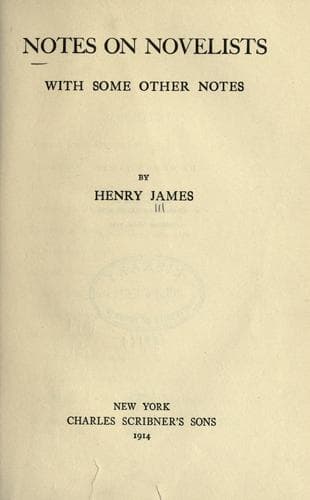
Notes on Novelists, with Some Other NotesJames, Henry
History
Notes on Novelists, with Some Other Notes
James, Henry
Fiction -- History and criticism; Novelists
The main thing doubtless to agree with M. Faguet about, however, is the
wonder of the rate at which this genius for an infatuated grasp of the
environment could multiply the creatures swarming, and swarming at their
best to perfection, in that jungle of elements. A jungle certainly the
environment, the rank many-coloured picture of France, would have been
had it not really created in our observer the joy, thanks to his need of
a clear and marked order, of its becoming so arrangeable. Nothing could
interest us more than to note with our critic that such
multiplications—taken after all at such a rush—have to be paid for by
a sort of limitation of quality in each, the quality that, beyond a
certain point and after a certain allowance, ever looks askance at any
approach to what it may be figured as taking for _insolence_ of
quantity. Some inquiry into the general mystery of such laws of payment
would beckon us on had we the space—whereby we might glance a little at
the wondrous why and wherefore of the sacrifice foredoomed, the loss,
greater or less, of those ideals now compromised by the tarnished names
of refinement and distinction, yet which we are none the less, at our
decentest, still ashamed too entirely to turn our backs on, in the
presence of energies that, shaking the air by their embrace of the
common, tend to dispossess the rare of a certified place in it.
Delightful to the critical mind to estimate the point at which, in the
picture of life, a sense for the element of the rare ceases to consort
with a sense, necessarily large and lusty, for the varieties of the real
that super-abound. Reducible perhaps to some exquisite measure is this
point of fatal divergence. It declared itself, the divergence, in the
heart of Balzac’s genius; for nothing about him is less to be gainsaid
than that on the other or further side of a certain line of rareness
drawn his authority, so splendid on the hither or familiar side, is
sadly liable to lapse. It fails to take in whatever fine truth
experience may have vouchsafed to us about the highest kinds of temper,
the inward life of the mind, the _cultivated_ consciousness. His truest
and vividest people are those whom the conditions in which they are so
palpably embedded have simplified not less than emphasised; simplified
mostly to singleness of motive and passion and interest, to quite
measurably finite existence; whereas his ostensibly higher spirits,
types necessarily least observed and most independently thought out, in
the interest of their humanity, as we would fain ourselves think them,
are his falsest and weakest and show most where his imagination and his
efficient sympathy break down.
Public-domain text, read in full here on John Shaqi.
Reviews
Reviews
No reviews yet
Be the first to share your thoughts on this work.
Elsewhere in the archive
Join the Discussion
Join the discussion
Sign in to leave a comment or review.
Sign InorCreate an account