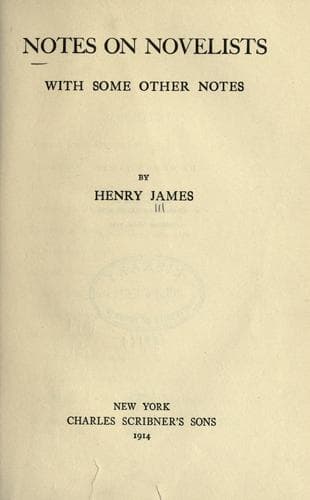
Notes on Novelists, with Some Other NotesJames, Henry
History
Notes on Novelists, with Some Other Notes
James, Henry
Fiction -- History and criticism; Novelists
It is not that the series of the Rougon-Macquart has not several
distinct men and women to show—though they occur, as a fact, almost in
“L’Assommoir” alone; it is not either that Zola did not on occasion try
for the cultivated consciousness, a thing of course, so far as ever
achieved anywhere, necessarily separate and distinguished; it is that he
tried, on such ground, with a futility only a shade less marked than
Balzac’s, and perhaps would have tried with equal disaster had he
happened to try oftener. If we find in his pages no such spreading waste
as Balzac’s general picture of the classes “enjoying every advantage,”
that is of the socially highest—to the elder writer’s success in
depicting particularly the female members of which Sainte-Beuve, and
Brunetière in his footsteps, have rendered such strange and stupefying
homage—the reason may very well be that such groups could not in the
nature of the case figure to him after the fashion in which he liked
groups to figure, as merely herded and compressed. To Balzac they were
groups in which individualisation might be raised to its very finest;
and it is by this possibility in them that we watch him and his fertile
vulgarity, his peccant taste, so fallible for delicacies, so unerring
for simplicities, above all doubtless the homeliest, strongest and
grimmest, wofully led astray. But it is fairly almost a pleasure to our
admiration, before him, to see what we have permitted ourselves to call
the “chunks” of excision carted off to the disengagement of the values
that still live. The wondrous thing is that they live best where his
grand vulgarity—since we are not afraid of the word—serves him rather
than betrays; which it _has_ to do, we make out, over the greater part
of the field of any observer for whom man is on the whole cruelly,
crushingly, deformedly conditioned. We grant _that_ as to Balzac’s view,
and yet feel the view to have been at the same time incomparably active
and productively genial; which are by themselves somehow qualities and
reactions that redress the tragedy and the doom. The vulgarity was at
any rate a force that simply got nearer than any other could have done
to the whole detail, the whole intimate and evidenced story, of
submission and perversion, and as such it could but prove itself
immensely human. It is on all this considered ground that he has for so
many years stood firm and that we feel him by reason of it and in spite
of them, in spite of all that has come and gone, not to have yielded,
have “given,” an inch.
-----
Footnote 5:
Balzac. Par Émile Faguet, de l’Académie Française. Les Grands Écrivains
Français. Paris, Hachette, 1913.
GEORGE SAND
1897
Public-domain text, read in full here on John Shaqi.
Reviews
Reviews
No reviews yet
Be the first to share your thoughts on this work.
Elsewhere in the archive
Join the Discussion
Join the discussion
Sign in to leave a comment or review.
Sign InorCreate an account