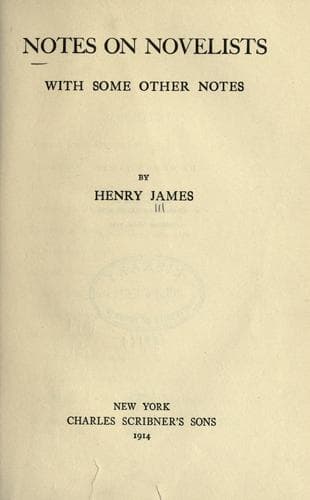
Notes on Novelists, with Some Other NotesJames, Henry
History
Notes on Novelists, with Some Other Notes
James, Henry
Fiction -- History and criticism; Novelists
I have been reading in the Revue de Paris for November 1st, 1896, some
fifty pages, of an extraordinary interest, which have had in respect to
an old admiration a remarkable effect. Undoubtedly for other admirers
too who have come to fifty year—admirers, I mean, once eager, of the
distinguished woman involved—the perusal of the letters addressed by
George Sand to Alfred de Musset in the course of a famous friendship
will have stirred in an odd fashion the ashes of an early ardour. I
speak of ashes because early ardours for the most part burn themselves
out, while the place they hold in our lives varies, I think, mainly
according to the degree of tenderness with which we gather up and
preserve their dust; and I speak of oddity because in the present case
it is difficult to say whether the agitation of the embers results at
last in a returning glow or in a yet more sensible chill. That indeed is
perhaps a small question compared with the simple pleasure of the
reviving emotion. One reads and wonders and enjoys again, just for the
sake of the renewal. The small fry of the hour submit to further
shrinkage, and we revert with a sigh of relief to the free genius and
large life of one of the greatest of all masters of expression. Do
people still handle the works of this master—people other than young
ladies studying French with La “Mare au Diable” and a dictionary? Are
there persons who still read “Valentine”? Are there others capable of
losing themselves in “Mauprat”? Has “André,” the exquisite, dropped out
of knowledge, and is any one left who remembers “Teverino”? I ask these
questions for the mere sweet sound of them, without the least
expectation of an answer. I remember asking them twenty years ago, after
Madame Sand’s death, and not then being hopeful of the answer of the
future. But the only response that matters to us perhaps is our own,
even if it be after all somewhat ambiguous. “André” and “Valentine” then
are rather on our shelves than in our hands, but in the light of what is
given us in the “Revue de Paris” who shall say that we do not, and with
avidity, “read” George Sand? She died in 1876, but she lives again
intensely in these singular pages, both as to what in her spirit was
most attaching and what most disconcerting. We are vague as to what they
may represent for the generation that has come to the front since her
death; nothing, I dare say, very imposing or even very pleasing. But
they give out a great deal to a reader for whom thirty years ago—the
best time to have taken her as a whole—she was a high clear figure, a
great familiar magician. This impression is a strange mixture, but
perhaps not quite incommunicable; and we are steeped as we receive it in
one of the most curious episodes in the annals of the literary race.
I
Public-domain text, read in full here on John Shaqi.
Reviews
Reviews
No reviews yet
Be the first to share your thoughts on this work.
Elsewhere in the archive
Join the Discussion
Join the discussion
Sign in to leave a comment or review.
Sign InorCreate an account