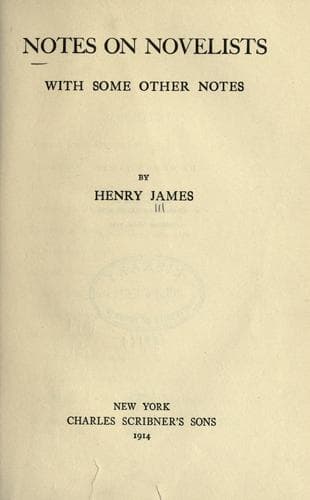
Notes on Novelists, with Some Other NotesJames, Henry
History
Notes on Novelists, with Some Other Notes
James, Henry
Fiction -- History and criticism; Novelists
It may be objected that this moral is qualified to come home to us only
when the relation between art and experience really proves a happier one
than it may be held to have proved in the combination before us. The
element in danger of being most absent from the process is the element
of dignity, and its presence, so far as that may ever at all be hoped
for in an appeal from a personal quarrel, is assured only in proportion
as the esthetic event, standing on its own feet, represents a noble
gift. It was vain, the objector may say, for our author to pretend to
justify by so slight a performance as “Elle et Lui” that sacrifice of
all delicacy which has culminated in this supreme surrender. “If you
sacrifice all delicacy,” I hear such a critic contend, “show at least
that you were right by giving us a masterpiece. The novel in question is
no more a masterpiece,” I even hear him proceed, “than any other of the
loose liquid lucid works of its author. By your supposition of a great
intention you give much too fine an account on the one hand of a
personal habit of incontinence and on the other of a literary habit of
egotism. Madame Sand, in writing her tale and in publishing her
love-letters, obeyed no prompting more exalted than that of exhibiting
her personal (in which I include her verbal) facility, and of doing so
at the cost of whatever other persons might be concerned; and you are
therefore—and you might as well immediately confess it—thrown back for
the element of interest on the attraction of her general eloquence, the
plausibility of her general manner and the great number of her
particular confidences. You are thrown back on your mere curiosity or
sympathy—thrown back from any question of service rendered to ‘art.’ ”
One might be thrown back doubtless still further even than such remarks
would represent if one were not quite prepared with the confession they
propose. It is only because such a figure is interesting—in every
manifestation—that its course is marked for us by vivid footprints and
possible lessons. And to enable us to find these it scarcely need have
aimed after all so extravagantly high. George Sand lived her remarkable
life and drove her perpetual pen, but the illustration that I began by
speaking of is for ourselves to gather—if we can.
Public-domain text, read in full here on John Shaqi.
Reviews
Reviews
No reviews yet
Be the first to share your thoughts on this work.
Elsewhere in the archive
Join the Discussion
Join the discussion
Sign in to leave a comment or review.
Sign InorCreate an account