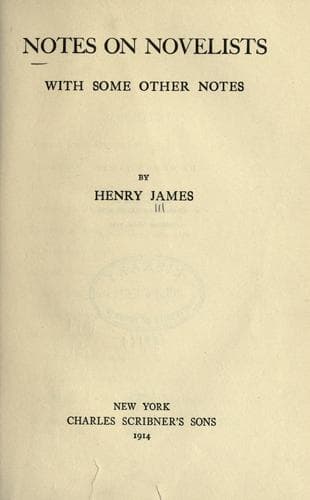
Notes on Novelists, with Some Other NotesJames, Henry
History
Notes on Novelists, with Some Other Notes
James, Henry
Fiction -- History and criticism; Novelists
I remember hearing many years ago in Paris an anecdote for the truth of
which I am far from vouching, though it professed to come direct—an
anecdote that has recurred to me more than once in turning over the
revelations of the Revue de Paris, and without the need of the special
reminder (in the shape of an allusion to her intimacy with the hero of
the story) contained in those letters to Sainte-Beuve which are
published in the number of November 15th. Prosper Mérimée was said to
have related—in a reprehensible spirit—that during a term of
association with the author of “Lélia” he once opened his eyes, in the
raw winter dawn, to see his companion, in a dressing-gown, on her knees
before the domestic hearth, a candlestick beside her and a red _madras_
round her head, making bravely, with her own hands, the fire that was to
enable her to sit down betimes to urgent pen and paper. The story
represents him as having felt that the spectacle chilled his ardour and
tried his taste; her appearance was unfortunate, her occupation an
inconsequence and her industry a reproof—the result of all of which was
a lively irritation and an early rupture. To the firm admirer of Madame
Sand’s prose the little sketch has a very different value, for it
presents her in an attitude which is the very key to the enigma, the
answer to most of the questions with which her character confronts us.
She rose early because she was pressed to write, and she was pressed to
write because she had the greatest instinct of expression ever conferred
on a woman; a faculty that put a premium on all passion, on all pain, on
all experience and all exposure, on the greatest variety of ties and the
smallest reserve about them. The really interesting thing in these
posthumous _laideurs_ is the way the gift, the voice, carries its
possessor through them and lifts her on the whole above them. It gave
her, it may be confessed at the outset and in spite of all magnanimities
in the use of it, an unfair advantage in every connection. So at least
we must continue to feel till—for our appreciation of this particular
one—we have Alfred de Musset’s share of the correspondence. For we
shall have it at last, in whatever faded fury or beauty it may still
possess—to that we may make up our minds. Let the galled jade wince, it
is only a question of time. The greatest of literary quarrels will in
short, on the general ground, once more come up—the quarrel beside
which all others are mild and arrangeable, the eternal dispute between
the public and the private, between curiosity and delicacy.
Public-domain text, read in full here on John Shaqi.
Reviews
Reviews
No reviews yet
Be the first to share your thoughts on this work.
Elsewhere in the archive
Join the Discussion
Join the discussion
Sign in to leave a comment or review.
Sign InorCreate an account