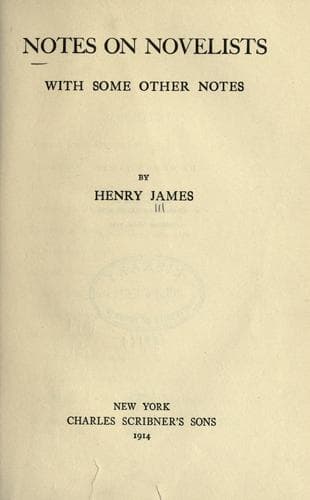
Notes on Novelists, with Some Other NotesJames, Henry
History
Notes on Novelists, with Some Other Notes
James, Henry
Fiction -- History and criticism; Novelists
It was not in the tower of art that George Sand ever shut herself up;
but I come back to a point already made in saying that it is in the
citadel of style that, notwithstanding rash _sorties_, she continues to
hold out. The outline of the complicated story that was to cause so much
ink to flow gives, even with the omission of a hundred features, a
direct measure of the strain to which her astonishing faculty was
exposed. In the summer of 1833, as a woman of nearly thirty, she
encountered Alfred de Musset, who was six years her junior. In spite of
their youth they were already somewhat bowed by the weight of a troubled
past. Musset, at twenty-three, had that of his confirmed libertinism—so
Madame Arvède Barine, who has had access to materials, tells us in the
admirable short biography of the poet contributed to the rather markedly
unequal but very interesting series of Hachette’s Grands Écrivains
Français. Madame Sand had a husband, a son and a daughter, and the
impress of that succession of lovers—Jules Sandeau had been one,
Prosper Mérimée another—to which she so freely alludes in the letters
to Sainte-Beuve, a friend more disinterested than these and qualified to
give much counsel in exchange for much confidence. It cannot be said
that the situation of either of our young persons was of good omen for a
happy relation, but they appear to have burnt their ships with much
promptitude and a great blaze, and in the December of that year they
started together for Italy. The following month saw them settled, on a
frail basis, in Venice, where the elder companion remained till late in
the summer of 1834 and where she wrote, in part, “Jacques” and the
“Lettres d’un Voyageur,” as well as “André” and “Léone-Léoni,” and
gathered the impressions to be embodied later in half-a-dozen stories
with Italian titles—notably in the delightful “Consuelo.” The journey,
the Italian climate, the Venetian winter at first agreed with neither of
the friends; they were both taken ill—the young man very gravely—and
after a stay of three months Musset returned, alone and much ravaged, to
Paris.
Public-domain text, read in full here on John Shaqi.
Reviews
Reviews
No reviews yet
Be the first to share your thoughts on this work.
Elsewhere in the archive
Join the Discussion
Join the discussion
Sign in to leave a comment or review.
Sign InorCreate an account