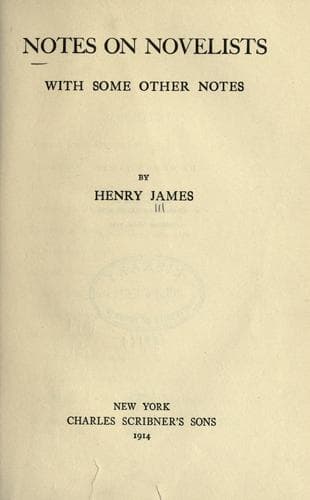
Notes on Novelists, with Some Other NotesJames, Henry
History
Notes on Novelists, with Some Other Notes
James, Henry
Fiction -- History and criticism; Novelists
In the meantime a great deal had happened, for their union had been
stormy and their security small. Madame Sand had nursed her companion in
illness (a matter-of-course office, it must be owned) and her companion
had railed at his nurse in health. A young physician, called in, had
become a close friend of both parties, but more particularly a close
friend of the lady, and it was to his tender care that on quitting the
scene Musset solemnly committed her. She took up life with Pietro
Pagello—the transition is startling—for the rest of her stay, and on
her journey back to France he was no inconsiderable part of her luggage.
He was simple, robust and kind—not a man of genius. He remained,
however, but a short time in Paris; in the autumn of 1834 he returned to
Italy, to live on till our own day but never again, so far as we know,
to meet his illustrious mistress. Her intercourse with her poet was, in
all its intensity, one may almost say its ferocity, promptly renewed,
and was sustained in that key for several months more. The effect of
this strange and tormented passion on the mere student of its records is
simply to make him ask himself what on earth is the matter with the
subjects of it. Nothing is more easy than to say, as I have intimated,
that it has no need of records and no need of students; but this leaves
out of account the thick medium of genius in which it was foredoomed to
disport itself. It was self-registering, as the phrase is, for the
genius on both sides happened to be the genius of eloquence. It is all
rapture and all rage and all literature. The “Lettres d’un Voyageur”
spring from the thick of the fight; “La Confession d’un Enfant du
Siècle” and “Les Nuits” are immediate echoes of the concert. The lovers
are naked in the market-place and perform for the benefit of society.
The matter with them, to the perception of the stupefied spectator, is
that they entertained for each other every feeling in life but the
feeling of respect. What the absence of that article may do for the
passion of hate is apparently nothing to what it may do for the passion
of love.
Public-domain text, read in full here on John Shaqi.
Reviews
Reviews
No reviews yet
Be the first to share your thoughts on this work.
Elsewhere in the archive
Join the Discussion
Join the discussion
Sign in to leave a comment or review.
Sign InorCreate an account