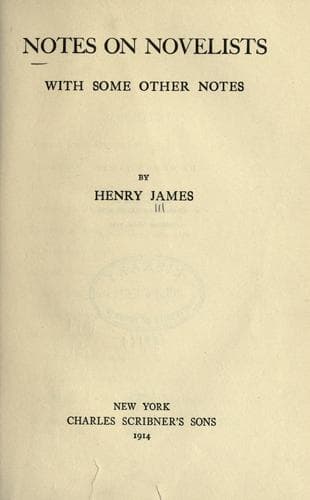
Notes on Novelists, with Some Other NotesJames, Henry
History
Notes on Novelists, with Some Other Notes
James, Henry
Fiction -- History and criticism; Novelists
He communicates to his confidant with the eagerness of a boy
confabulating in holidays over a Christmas charade; but I remember no
instance of his expressing a subject, as one may say, as a
subject—hinting at what novelists mainly know, one would imagine, as
the determinant thing in it, the idea out of which it springs. The form,
the envelope, is there with him, headforemost, _as_ the idea; titles,
names, that is, chapters, sequences, orders, while we are still asking
ourselves how it was that he primarily put to his own mind what it was
all to be about. He simply _felt_ this, evidently, and it is always the
one dumb sound, the stopped pipe or only unexpressed thing, in all his
contagious candour. He finds none the less in the letter to which I
refer one of the problems of the wonderful projected “Sophia Scarlet”
“exactly a Balzac one, and I wish I had his fist—for I have already a
better method—the kinetic—whereas he continually allowed himself to be
led into the static.” There we have him—Stevenson, not Balzac—at his
most overflowing, and after all radiantly capable of conceiving at
another moment that his “better method” would have been none at all for
Balzac’s vision of a subject, least of all of _the_ subject, the whole
of life. Balzac’s method was adapted to his notion of
presentation—which we may accept, it strikes me, under the protection
of what he presents. Were it not, in fine, as I may repeat, to embark in
a bigger boat than would here turn round I might note further that
Stevenson has elsewhere—was disposed in general to have—too short a
way with this master. There is an interesting passage in which he
charges him with having never known what to leave out, a passage which
has its bearing on condition of being read with due remembrance of the
class of performance to which “Le Colonel Chabert,” for instance, “Le
Curé de Tours,” “L’Interdiction,” “La Messe de l’Athée” (to name but a
few brief masterpieces in a long list) appertain.
Public-domain text, read in full here on John Shaqi.
Reviews
Reviews
No reviews yet
Be the first to share your thoughts on this work.
Join the Discussion
Join the discussion
Sign in to leave a comment or review.
Sign InorCreate an account