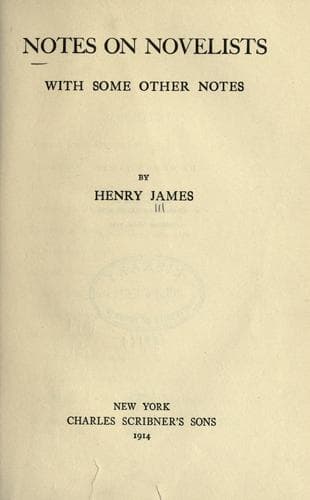
Notes on Novelists, with Some Other NotesJames, Henry
History
Notes on Novelists, with Some Other Notes
James, Henry
Fiction -- History and criticism; Novelists
had from another and thereby inevitably becoming more general and
superficial, missing or forgetting the “hard” parts and slurring them
over and making them up. Of everything but feelings the presentation is
dim. We recognise that we shall never know the original narrator and
that the actual introducer is the only one we can deal with. But we sigh
perhaps as we reflect that we may never confront her with her own
informant.
To that, however, we must resign ourselves; for I remember in time that
the volume from which I take occasion to speak with this levity is the
work that I began by pronouncing a precious illustration. With the aid
of the disclosures of the Revue de Paris it was, as I hinted, to show us
that no mistakes and no pains are too great to be, in the air of art,
triumphantly convertible. Has it really performed this function? I thumb
again my copy of the limp little novel and wonder what, alas, I shall
reply. The case is extreme, for it was the case of a suggestive
experience particularly dire, and the literary flower that has bloomed
upon it is not quite the full-blown rose. “Oeuvre de rancune” Arvède
Barine pronounces it, and if we take it as that we admit that the
artist’s distinctness from her material was not ideally complete. Shall
I not better the question by saying that it strikes me less as a work of
rancour than—in a peculiar degree—as a work of egotism? It becomes in
that light at any rate a sufficiently happy affirmation of the author’s
infallible form. This form was never a more successful vehicle for the
conveyance of sweet reasonableness. It is all superlatively calm and
clear; there never was a kinder, balmier last word. Whatever the measure
of justice of the particular representation, moreover, the picture has
only to be put beside the recent documents, the “study,” as I may call
them, to illustrate the general phenomenon. Even if “Elle et Lui” is not
the full-blown rose we have enough here to place in due relief an
irrepressible tendency to bloom. In fact I seem already to discern that
tendency in the very midst of the storm; the “tone” in the letters too
has its own way and performs on its own account—which is but another
manner of saying that the literary instinct, in the worst shipwreck, is
never out of its depth. The worker observed at the fire by Mérimée could
be drowned but in an ocean of ink. Is that a sufficient account of what
I have called the laying bare of the relation between experience and
art? With the two elements, the life and the genius, face to face—the
smutches and quarrels at one end of the chain and the high luminosity at
the other—does some essential link still appear to be missing? How do
the graceless facts after all confound themselves with the beautiful
spirit? They do so, incontestably, before our eyes, and the
mystification remains. We try to trace the process, but before we break
down we had better perhaps hasten to grant that—so far at least as
Public-domain text, read in full here on John Shaqi.
Reviews
Reviews
No reviews yet
Be the first to share your thoughts on this work.
Elsewhere in the archive
Join the Discussion
Join the discussion
Sign in to leave a comment or review.
Sign InorCreate an account