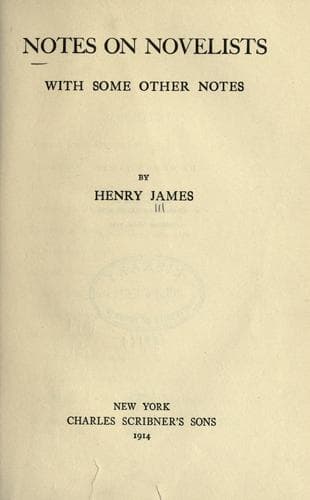
Notes on Novelists, with Some Other NotesJames, Henry
History
Notes on Novelists, with Some Other Notes
James, Henry
Fiction -- History and criticism; Novelists
outward flourishes, she saw it confidently come back. She herself lived
with all her perceptions and in all her chambers—not merely in the
showroom of the shop. This brings us once more to the question of the
instrument and the tone, and to our idea that the tone, when you are so
lucky as to possess it, may be of itself a solution.
By a solution I mean a secret for saving not only your reputation but
your life—that of your soul; an antidote to dangers which the unendowed
can hope to escape by no process less uncomfortable or less inglorious
than that of prudence and precautions. The unendowed must go round
about, the others may go straight through the wood. Their weaknesses,
those of the others, shall be as well redeemed as their books shall be
well preserved; it may almost indeed be said that they are made wise in
spite of themselves. If you have never in all your days _had_ a weakness
worth mentioning, you can be after all no more, at the very most, than
large and cheerful and imperturbable. All these things Madame Sand
managed to be on just the terms she had found, as we see, most
convenient. So much, I repeat, does there appear to be in a tone. But if
the perfect possession of one made her, as it well might, an optimist,
the action of it is perhaps more consistently happy in her letters and
her personal records than in her “creative” work. Her novels to-day have
turned rather pale and faint, as if the image projected—not intense,
not absolutely concrete—failed to reach completely the mind’s eye. And
the odd point is that the wonderful charm of expression is not really a
remedy for this lack of intensity, but rather an aggravation of it
through a sort of suffusion of the whole thing by the voice and speech
of the author. These things set the subject, whatever it be, afloat in
the upper air, where it takes a happy bath of brightness and vagueness
or swims like a soap-bubble kept up by blowing. This is no drawback when
she is on the ground of her own life, to which she is tied by a certain
number of tangible threads; but to embark on one of her confessed
fictions is to have—after all that has come and gone, in our time, in
the trick of persuasion—a little too much the feeling of going up in a
balloon. We are borne by a fresh cool current and the car delightfully
dangles; but as we peep over the sides we see things—as we usually know
them—at a dreadful drop beneath. Or perhaps a better way to express the
sensation is to say what I have just been struck with in the re-perusal
of “Elle et Lui”; namely that this book, like others by the same hand,
affects the reader—and the impression is of the oddest—not as a first
but as a second echo or edition of the immediate real, or in other words
of the subject. The tale may in this particular be taken as typical of
the author’s manner; beautifully told, but told, as if on a last remove
from the facts, by some one repeating what he has read or what he has
Public-domain text, read in full here on John Shaqi.
Reviews
Reviews
No reviews yet
Be the first to share your thoughts on this work.
Elsewhere in the archive
Join the Discussion
Join the discussion
Sign in to leave a comment or review.
Sign InorCreate an account