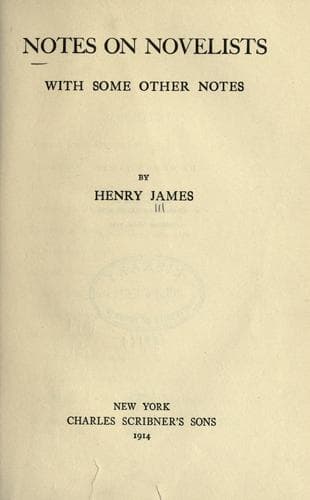
Notes on Novelists, with Some Other NotesJames, Henry
History
Notes on Novelists, with Some Other Notes
James, Henry
Fiction -- History and criticism; Novelists
Mme. Wladimir Karénine’s extraordinarily diffuse, but scarcely less
valuable, biography, of which the first instalment,[6] in two large
volumes, brings the story but to the year 1838, reaches us in a French
version, apparently from the author’s own hand, of chapters patiently
contributed to Russian periodicals. Were it not superficially ungrateful
to begin with reserves about a book so rich and full, there might be
some complaint to make of this wonderful tribute on grounds of form and
taste. Ponderous and prolix, the author moves in a mass, escorted by all
the penalties of her indifference to selection and compression. She
insists and repeats, she wanders wide; her subject spreads about her, in
places, as rather a pathless waste. Above all she has produced a book
which manages to be at once remarkably expert and singularly provincial.
Our innocence is perhaps at fault, but we are moved to take the mixture
for characteristically Russian. Would indeed any but that admirable
“Slav” superiority to prejudice of which we have lately heard so much
have availed to handle the particular facts in this large free way?
Nothing is at all events more curious than the union, on the part of our
biographer, of psychological intelligence and a lame esthetic. The
writer’s literary appreciations lag in other words half a century behind
her human and social. She treats us to endless disquisitions on pages of
her author to which we are no longer in any manageable relation at
all—disquisitions pathetic, almost grotesque, in their misplaced good
faith. But her attitude to her subject is admirable, her thoroughness
exemplary, the spirit of service in her of the sort that builds the
monument stone by stone. When we see it reared to the summit, as we are
clearly to do, we shall feel the structure to be solid if not shapely.
Nothing is more possible meanwhile than that a culture more
homogeneous—a French hand or a German—could not have engaged in the
work with anything like the same sincerity. An English hand—and the
fact, for _our_ culture, means much—would have been incapable of
touching it. The present scale of it at all events is certainly an
exotic misconception. But we can take of it what concerns us.
Public-domain text, read in full here on John Shaqi.
Reviews
Reviews
No reviews yet
Be the first to share your thoughts on this work.
Elsewhere in the archive
Join the Discussion
Join the discussion
Sign in to leave a comment or review.
Sign InorCreate an account