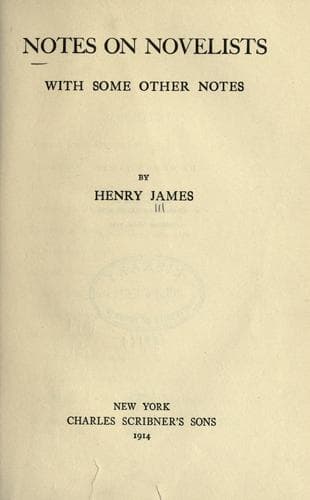
Notes on Novelists, with Some Other NotesJames, Henry
History
Notes on Novelists, with Some Other Notes
James, Henry
Fiction -- History and criticism; Novelists
The whole thing of course, we promptly reflect, concerns at the best
only those of us who can remount a little the stream of time. The author
of “L’Histoire de ma Vie” died in 1876, and the light of actuality rests
to-day on very different heads. It may seem to belittle her to say that
to care for her at all one must have cared for her from far back, for
such is not in general the proviso we need to make on behalf of the
greatest figures. It describes Madame Sand with breadth, but not with
extravagance, to speak of her as a sister to Goethe, and we feel that
for Goethe it can never be too late to care. But the case exemplifies
perhaps precisely the difference even in the most brilliant families
between sisters and brothers. She was to have the family spirit, but she
was to receive from the fairies who attended at her cradle the silver
cup, not the gold. She was to write a hundred books but she was not to
write “Faust.” She was to have all the distinction but not all the
perfection; and there could be no better instance of the degree in which
a woman may achieve the one and still fail of the other. When it is a
question of the rare originals who have either she confirms us,
masculine as she is, in believing that it takes a still greater
masculinity to have both. What she had, however, she had in profusion;
she was one of the deepest voices of that great mid-century concert
against the last fine strains of which we are more and more banging the
doors. Her work, beautiful, plentiful and fluid, has floated itself out
to sea even as the melting snows of the high places are floated. To feel
how she has passed away as a “creator” is to feel anew the immense waste
involved in the general ferment of an age, and how much genius and
beauty, let alone the baser parts of the mixture, it takes to produce a
moderate quantity of literature. Smaller people have conceivably ceased
to count; but it is strange for a member of the generation immediately
succeeding her own that she should have had the same fate as smaller
people: all the more that such a mourner may be ruefully conscious of
contributing not a little himself to the mishap. Does he still read,
re-read, can he to-day at all deal with, this wonderful lady’s novels?
It only half cheers him up that on the occasion of such a publication as
I here speak of he finds himself as much interested as ever.
Public-domain text, read in full here on John Shaqi.
Reviews
Reviews
No reviews yet
Be the first to share your thoughts on this work.
Elsewhere in the archive
Join the Discussion
Join the discussion
Sign in to leave a comment or review.
Sign InorCreate an account