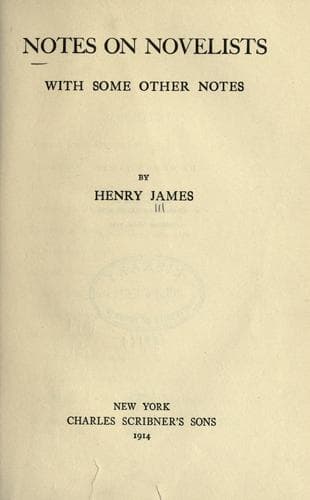
Notes on Novelists, with Some Other NotesJames, Henry
History
Notes on Novelists, with Some Other Notes
James, Henry
Fiction -- History and criticism; Novelists
Such is far from usually the case, I hasten to recognise, with the
complete and consistent artist. Poor is the art, a thing positively to
be ashamed of, that, generally speaking, is not far more pressing for
this servant of the altar than anything else, anything outside the
church, can possibly be. To have been the tempered and directed hammer
that makes the metal hard: if that be not good enough for such a
ministrant, we may know him by whatever he has found better—we shall
not know him by the great name. The immense anomaly in Madame Sand was
that she freely took the form of being, with most zest, quite another
sort of hammer. It testifies sufficiently to her large endowment that,
given the wide range of the rest of her appetite, she should seem to us
to-day to have sacrificed even superficially to _any_ form of objective
expression. She had in spite of herself an imagination almost of the
first order, which overflowed and irrigated, turning by its mere swift
current, without effort, almost without direction, every mill it
encountered, and launching as it went alike the lightest skiff and the
stateliest ship. She had in especial the gift of speech, speech supreme
and inspired, to which we particularly owe the high value of the “case”
she presents. For the case was definitely a bold and direct experiment,
not at all in “art,” not at all in literature, but conspicuously and
repeatedly in the business of living; so that our profit of it is before
anything else that it was conscious, articulate, vivid—recorded,
reflected, imaged. The subject of the experiment became also at first
hand the journalist—much of her work being simply splendid
journalism—commissioned to bring it up to date. She interviewed nobody
else, but she admirably interviewed herself, and this is exactly our
good fortune. Her autobiography, her letters, her innumerable prefaces,
all her expansive parentheses and excursions, make up the generous
report. We have in this form accordingly a literary title for her far
superseding any derived from her creative work. But that is the result
of a mere betrayal, not the result of an intention. Her masterpiece, by
a perversity of fate, is the thing she least sat down to. It
consists—since she is a case—in the mere notation of her symptoms, in
help given to the study of them. To this has the author of “Consuelo”
come.
Public-domain text, read in full here on John Shaqi.
Reviews
Reviews
No reviews yet
Be the first to share your thoughts on this work.
Elsewhere in the archive
Join the Discussion
Join the discussion
Sign in to leave a comment or review.
Sign InorCreate an account