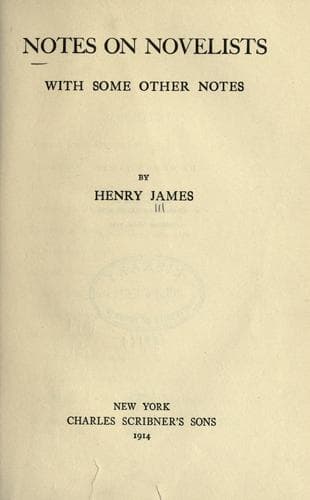
Notes on Novelists, with Some Other NotesJames, Henry
History
Notes on Novelists, with Some Other Notes
James, Henry
Fiction -- History and criticism; Novelists
But how in the world indeed was the point so indicated _not_ to be the
particular cross-road at which the critic should lie in wait for a poor
child of the age whom preceding ages and generations had almost
infernally conspired to trap for him, to give up, candidly astray, to
his hands? If the element of romance for which our heroine’s name stands
is best represented by her personal sequences and solutions, it is
sufficiently visible that her heredity left her a scant alternative.
Space fails me for the story of this heredity, queer and complicated,
the very stuff that stories are made of—a chain of generations
succeeding each other in confidence and joy and with no aid asked of
legal or other artificial sanctions. The facts are, moreover,
sufficiently familiar, though here as elsewhere Madame Karénine adds to
our knowledge. Presented, foreshortened, stretching back from the quiet
Nohant funeral of 1876 to the steps of the throne of King Augustus the
Strong of Poland, father of Maurice de Saxe, great-great-grandfather of
Aurore Dupin, it all hangs together as a cluster of components more
provocative than any the great novelist herself ever handled. Her
pre-natal past was so peopled with _dramatis personæ_ that her future
was really called on to supply them in such numbers as would preserve
the balance. The tide of illegitimacy sets straight through the series.
No one to speak of—Aurore’s father is an exception—seems to have had a
“regular” paternity. Aurore herself squared with regularity but by a
month or two; the marriage of her parents gave her a bare escape. She
was brought up by her paternal grandmother between a son of her father
and a daughter of her mother born out of wedlock. It all moves before us
as a vivid younger world, a world on the whole more amused and more
amusing than ours. The period from the Restoration to the events of 1848
is the stretch of time in which, for more reasons than we can now go
into, French life gives out to those to whom its appeal never fails most
of its charm—most, at all events, of its ancient sociability. Happy is
our sense of the picturesque Paris unconscious of a future all “avenues”
and exhibitions; happy our sense of these middle years of a great
generation, easy and lusty despite the ensanguined spring that had gone
before. They live again, piecing themselves ever so pleasantly and
strangely together, in Madame Sand’s records and references; almost as
much as the conscious close of the old régime so vaunted by Talleyrand
they strike us as a season it would have been indispensable to know for
the measure of what intercourse could richly be.
Public-domain text, read in full here on John Shaqi.
Reviews
Reviews
No reviews yet
Be the first to share your thoughts on this work.
Elsewhere in the archive
Join the Discussion
Join the discussion
Sign in to leave a comment or review.
Sign InorCreate an account