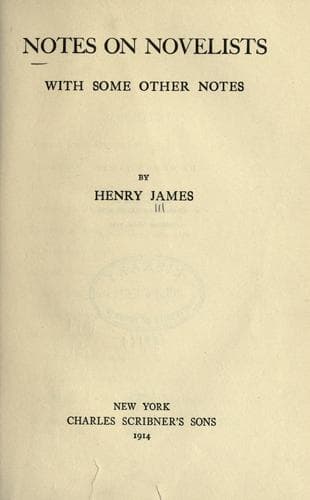
Notes on Novelists, with Some Other NotesJames, Henry
History
Notes on Novelists, with Some Other Notes
James, Henry
Fiction -- History and criticism; Novelists
The time was at any rate unable to withhold from the wonderful young
person growing up at Nohant the conditions she was so freely to use as
measures of her own. Though the motto of her autobiography is _Wahrheit
und Dichtung_ quite as much as it had been that of Goethe’s, there is a
truth beyond any projected by her more regular compositions in her
evocation of the influences of her youth. Upon these influences Madame
Karénine, who has enjoyed access through her heroine’s actual
representatives to much evidence hitherto unpublished, throws a hundred
interesting lights. Madame Dupin de Francueil and Madame Dupin the
younger survive and perform for us, “convince” us as we say, better than
any Lélia or any Consuelo. Our author’s whole treatment of her
remarkable mother’s figure and history conveniently gives the critic the
pitch of the great fact about her—the formation apparently at a given
moment, yet in very truth, we may be sure, from far back, of the
capacity and the determination to live with high consistency for
herself. What she made of this resolve to allow her nature all its
chances and how she carried on the process—these things are, thanks to
the immense illustration her genius enabled her to lend them, the
essence of her story; of which the full adumbration is in the detached
pictorial way she causes her mother to live for us. Motherhood,
daughterhood, childhood, embarrassed maturity, were phenomena she early
encountered in her great adventure, and nothing is more typical of her
energy and sincerity than the short work we can scarce help feeling she
makes of them. It is not that she for a moment blinks or dodges them;
she weaves them straight in—embarks with them indeed as her principal
baggage. We know to-day from the pages before us everything we need to
know about her marriage and the troubled years that followed; about M.
Casimir Dudevant and his possible points of view, about her separation,
her sharp secession, rather, as it first presents itself, and her
discovery, at a turn of the road as it can only be called, of her
genius.
Public-domain text, read in full here on John Shaqi.
Reviews
Reviews
No reviews yet
Be the first to share your thoughts on this work.
Elsewhere in the archive
Join the Discussion
Join the discussion
Sign in to leave a comment or review.
Sign InorCreate an account