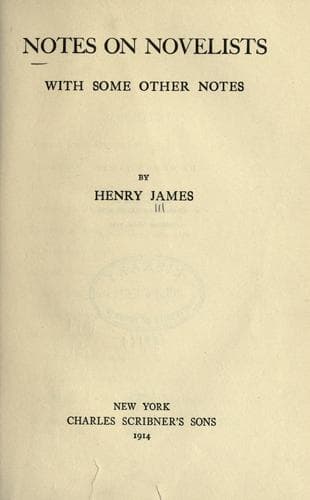
Notes on Novelists, with Some Other NotesJames, Henry
History
Notes on Novelists, with Some Other Notes
James, Henry
Fiction -- History and criticism; Novelists
We deal here, I think, with something very different from the usual
tittle-tattle about “private” relations, for the simple reason that we
deal with relations foredoomed to publicity by the strange economy
involved in the play of genius itself. Nothing was ever less wasted,
from beginning to end, than all this amorous experience and all this
luxury of woe. The parties to it were to make an inveterate use of it,
the principal party most of all; and what therefore on that marked
ground concerns the critic is to see what they were appreciably to get
out of it. The principal party, the constant one through all mutations,
was alone qualified to produce the extract that affects us as final. It
was by the publication four years since of her letters to Alfred de
Musset and to Sainte-Beuve, by the appearance also of Madame Arvède
Barine’s clear compact biography of Musset, that we began to find her
personal history brought nearer to us than her own communications had in
her lifetime already brought it. The story of her relations with Musset
is accordingly so known that I need only glance at the fact of her
having—shortly after the highest degree of intimacy between them had,
in the summer of 1833, established itself in Paris—travelled with him
to Italy, settled with him briefly in Venice, and there passionately
quarrelled and parted with him—only, however, several months later, on
their return to France, to renew again, to quarrel and to part again,
all more passionately, if possible, even than before. Madame Karénine,
besides supplying us with all added light on this episode, keeps us
abreast of others that were to follow, leaves us no more in the dark
about Michel de Bourges, Félicien Mallefille and Chopin than we had
already been left about their several predecessors. She is commendably
lucid on the subject of Franz Liszt, impartially examines the case and
authoritatively dismisses it. Her second volume brings her heroine to
the eve of the historic departure with Chopin for Majorca. We have thus
in a convenient form enough for one mouthful of entertainment, as well
as for superabundant reflection.
Public-domain text, read in full here on John Shaqi.
Reviews
Reviews
No reviews yet
Be the first to share your thoughts on this work.
Elsewhere in the archive
Join the Discussion
Join the discussion
Sign in to leave a comment or review.
Sign InorCreate an account