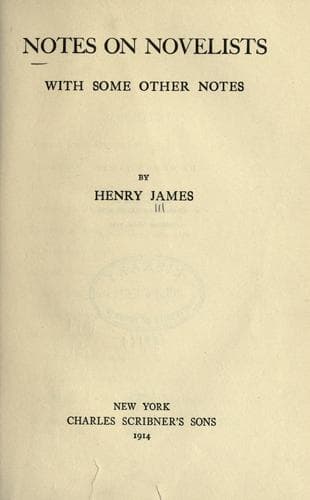
Notes on Novelists, with Some Other NotesJames, Henry
History
Notes on Novelists, with Some Other Notes
James, Henry
Fiction -- History and criticism; Novelists
We have indeed the whole essence of what most touches us, for this
consists not at all of the quantity of the facts, nor even of their
oddity: they are practically all there from the moment the heroine’s
general attitude defines itself. That is the solid element—the details
to-day are smoke. Yet I hasten to add that it was in particular by
taking her place of an autumn evening in the southward-moving diligence
with Alfred de Musset, it was on this special occasion that she gave
most the measure of her choice of the consistent, even though it so
little meant the consequent, life. She had reached toward such a life
obviously in quitting the conjugal roof in 1831—had attacked the
experiment clumsily, but according to her light, by throwing herself on
such material support as faculties yet untested might furnish, and on
such moral as several months of the _intimité_ of Jules Sandeau and a
briefer taste of that of Prosper Mérimée might further contribute. She
had done, in other words, what she could; subsequent lights show it as
not her fault that she had not done better. With Musset her future took
a long stride; emotionally speaking it “looked up.” Nothing was wanting
in this case—independently of what might then have appeared her
friend’s equal genius—quite ideally to qualify it. He was several years
her junior, and as she had her husband and her children, he had, in the
high degree of most young Frenchmen of sensibility, his mother. It is
recorded that with this lady on the eve of the celebrated step she quite
had the situation, as the phrase is, out; which is a note the more in
the general, the intellectual lucidity. The only other note in fact to
be added is that of the absence of funds for the undertaking. Neither
partner had a penny to spare; the plan was wholly to “make money,” on a
scale, as they went. A great deal was in the event, exactly speaking, to
be made—but the event was at the time far from clear to them. The
enterprise was in consequence purely and simply, with a rounded
perfection that gives it its value for the critic, an affair of the
heart. That the heart, taking it as a fully representative organ, should
fail of no good occasion completely and consistently to engage itself
was the definite and, as appeared, the promising assumption on which
everything rested. The heart was real life, frank, fearless, intelligent
and even, so far as might be, intelligible life; everything else was
stupid as well as poor, muddle as well as misery. The heart of course
might be misery, for nothing was more possible than that life
predominantly was; but it was at all events the misery that is least
ignoble.
Public-domain text, read in full here on John Shaqi.
Reviews
Reviews
No reviews yet
Be the first to share your thoughts on this work.
Elsewhere in the archive
Join the Discussion
Join the discussion
Sign in to leave a comment or review.
Sign InorCreate an account