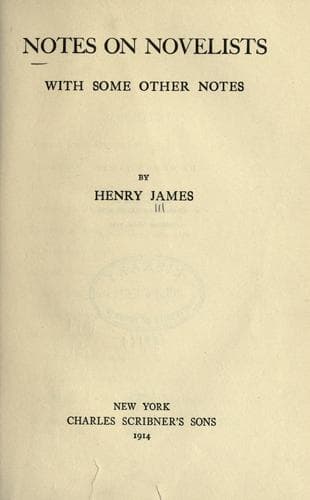
Notes on Novelists, with Some Other NotesJames, Henry
History
Notes on Novelists, with Some Other Notes
James, Henry
Fiction -- History and criticism; Novelists
In October, meanwhile, the connection with Musset was renewed, and
renewed—this is the great point—because the sentiments still
entertained by each (in spite of Pagello, in spite of everything) are
stronger even than any awkwardness of which either might have been
conscious. The whole business really is one in which we lose our measure
alike of awkwardness and of grace. The situation is in the hands of
comedy—or _would_ be, I should rather say, were it not so distinctly
predestined to fall, as I have noted, into those of the nobler form. It
is prolonged till the following February, we make out, at furthest, and
only after having been more than once in the interval threatened with
violent extinction. It bequeaths us thus in a handful of dates a picture
than which probably none other in the annals of “passion” was ever more
suggestive. The passion is of the kind that is called “immortal”—and so
called, wonderful to say, with infinite reason and justice. The poems,
the letters, the diaries, the novels, the unextinguished accents and
lingering echoes that commemorate it are among the treasures of the
human imagination. The literature of the world is appreciably the richer
for it. The noblest forms, in a word, on both sides, marked it for their
own; it was born, according to the adage, with a silver spoon in its
mouth. It was an affection in short transcendent and sublime, and yet
the critic sees it come and go before he can positively turn round. The
brief period of some seventeen or eighteen months not only affords it
all its opportunity, but places comfortably in its lap a relation
founded on the same elements and yet wholly distinct from it. Musset
occupied in fact but two-thirds of his mistress’s time. Pagello
overlapped him because Pagello also appealed to the heart; but Pagello’s
appeal to the heart was disposed of as expeditiously. Musset, in the
same way, succeeded Pagello at the voice of a similar appeal, and this
claim, in its turn, was polished off in yet livelier fashion.
Public-domain text, read in full here on John Shaqi.
Reviews
Reviews
No reviews yet
Be the first to share your thoughts on this work.
Elsewhere in the archive
Join the Discussion
Join the discussion
Sign in to leave a comment or review.
Sign InorCreate an account