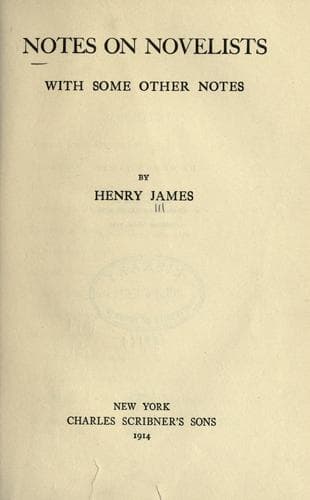
Notes on Novelists, with Some Other NotesJames, Henry
History
Notes on Novelists, with Some Other Notes
James, Henry
Fiction -- History and criticism; Novelists
Liveliness is of course the tune of the “gay” career; it has always been
supposed to relegate to comedy the things to which it puts its mark—so
that as a series of sequences amenable mainly to satire the
approximations I have made would fall neatly into place. The anomaly
here, as on other occasions of the same sort in Madame Karénine’s
volumes, is that the facts, as we are brought near to them, strike us as
so out of relation to the beautiful tone. The effect and the achieved
dignity are those of tragedy—tragedy rearranging, begetting afresh, in
its own interest, all the elements of ecstasy and despair. How can it
not be tragedy when this interest is just the interest, which I have
touched on, of exemplary eloquence? There are lights in which the
material, with its want of nobleness, want of temper, want even of
manners, seems scarcely life at all, as the civilised conscience
understands life; and yet it is as the most magnanimous of surrenders to
life that the whole business is triumphantly reflected in the documents.
It is not only that “La Nuit d’Octobre” is divine, that Madame Sand’s
letters are superb and that nothing can exceed, in particular, the high
style of the passage that we now perceive Musset to have borrowed from
one of them for insertion in “On ne Badine pas avec l’Amour”—to the
extreme profit of the generation which was, for many years thereafter,
to hear Delaunay exquisitely declaim it at the Théâtre Français; it is
that, strange to say, almost the finest flower of the bouquet is the
now-famous written “declaration” addressed to Pagello one evening by the
lady. Musset was ill in bed; he was the attendant doctor; and while,
watching and ignorant of French, he twirled his thumbs or dipped into a
book, his patient’s companion, on the other side of the table and with
the lamp between them, dashed off (it took time) a specimen of her
finest prose, which she then folded and handed to him, and which, for
perusal more at leisure, he carried off in his pocket. It proved neither
more nor less than one of the pontoon bridges which a force engaged in
an active campaign holds itself ready at any time to throw across a
river, and was in fact of its kind a stout and beautiful structure. It
happily spanned at all events the gulf of a short acquaintance.
Public-domain text, read in full here on John Shaqi.
Reviews
Reviews
No reviews yet
Be the first to share your thoughts on this work.
Elsewhere in the archive
Join the Discussion
Join the discussion
Sign in to leave a comment or review.
Sign InorCreate an account