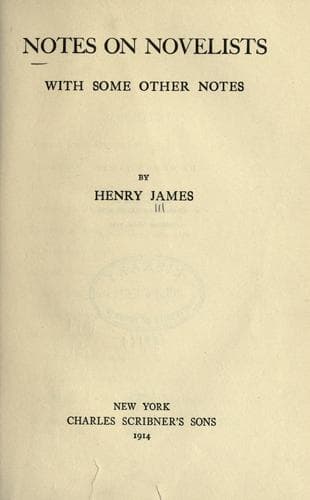
Notes on Novelists, with Some Other NotesJames, Henry
History
Notes on Novelists, with Some Other Notes
James, Henry
Fiction -- History and criticism; Novelists
are all round us unmistakable; the change is in the air; women are
turned more and more to looking at life as men look at it and to getting
from it what men get. In this direction their aim has been as yet
comparatively modest and their emulation low; the challenge they have
hitherto picked up is but the challenge of the “average” male. The
approximation of the extraordinary woman has been practically, in other
words, to the ordinary man. George Sand’s service is that she planted
the flag much higher—her own approximation at least was to the
extraordinary. She reached him, she surpassed him, and she showed how,
with native dispositions, the thing could be done. So far as we have
come these new records will live as the precious text-book of the
business.
-----
Footnote 6:
“George Sand, sa Vie et ses Œuvres, 1804-1876.” Paris, 1899.
GEORGE SAND
1914
It has much occurred to us, touching those further liberations of the
subordinate sex which fill our ears just now with their multitudinous
sound, that the promoters of the great cause make a good deal less than
they might of one of their very first contentious “assets,” if it may
not indeed be looked at as quite the first; and thereby fail to pass
about, to the general elation, a great vessel of truth. Is this because
the life and example of George Sand are things unknown or obscure to the
talkers and fighters of to-day—present and vivid as they were to those
of the last mid-century, or because of some fear that to invoke victory
in her name might, for particular, for even rueful reasons, not be
altogether a safe course? It is difficult to account otherwise for the
fact that so ample and embossed a shield, and one that shines too at
last with a strong and settled lustre, is rather left hanging on the
wall than seen to cover advances or ward off attacks in the fray.
Certain it is that if a lapse of tradition appeared at one time to have
left a little in the lurch the figure of the greatest of all women of
letters, of Letters in truth most exactly, as we hold her surely to have
been, that explanation should have begun to fail, some fourteen years
ago, with the publication of the first volume of Madame Wladimir
Karénine’s biography, and even in spite of the fact that this singularly
interesting work was not till a twelvemonth ago to arrive at the dignity
of a third,[7] which leaves it, for all its amplitude, still incomplete.
The latest instalment, now before us, follows its predecessors after an
interval that had alarmed us not a little for the proper consummation;
and the story is even now carried but to the eve of the Revolution of
1848, after which its heroine (that of the Revolution, we may almost
say, as well as of the narrative) was to have some twenty-seven years to
live. Madame Karénine appears to be a Russian critic writing under a
pseudonym; portions of her overbrimming study have appeared dispersedly,
Public-domain text, read in full here on John Shaqi.
Reviews
Reviews
No reviews yet
Be the first to share your thoughts on this work.
Elsewhere in the archive
Join the Discussion
Join the discussion
Sign in to leave a comment or review.
Sign InorCreate an account