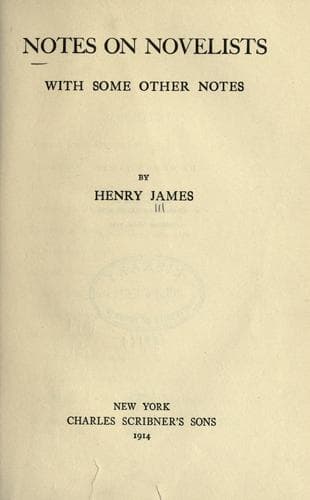
Notes on Novelists, with Some Other NotesJames, Henry
History
Notes on Novelists, with Some Other Notes
James, Henry
Fiction -- History and criticism; Novelists
The scene quite changes when we cease to expect these graces. As a man
Madame Sand was admirable—especially as a man of the dressing-gown and
slippers order, easy of approach and of _tutoiement_, rubbing shoulders
with queer company and not superstitiously haunted by the conception of
the gentleman. There have been many men of genius, delightful, prodigal
and even immortal, who squared but scantly with that conception, and it
is a company to which our heroine is simply one of the most interesting
of recruits. She has in it all her value and loses none of her charm.
Above all she becomes in a manner comprehensible, as any frank Bohemian
is comprehensible. We have only to imagine the Bohemian really endowed,
the Bohemian, that is, both industrious and wise, to get almost all her
formula. She keeps here and there a feminine streak—has at moments an
excess of volubility and too great an insistence on having been in the
right; but for the rest, as Balzac says, the character, confronted with
the position, is an explanation. “Son mâle,” he tells Madame Hanska,
“était rare”—than which nothing could have been more natural. Yet for
this masculine counterpart—so difficult to find—she ingenuously spent
much of her early life in looking. That the search was a mistake is what
constitutes, in all the business of which the Musset episode is the
type, the only, the real melancholy, the real moral tragedy.
For all such mistakes, none the less, the whole lesson of the picture is
precisely in the disconcerting success of her system. Everything was at
the start against that presumption; but everything at the end was to
indicate that she was not to have been defeated. Others might well have
been, and the banks of the stream of her career are marked, not
invisibly, with mouldering traces of the less lucky or the less buoyant;
but her attitude as life went on was more and more that of showing how
she profited of all things for wisdom and sympathy, for a general
expertness and nobleness. These forces, all clarified to an admirable
judgment, kept her to the last day serene and superior, and they are one
of the reasons why the monument before us is felt not to be misplaced.
There should always be a monument to those who have achieved a prodigy.
What greater prodigy than to have bequeathed in such mixed elements, to
have principally made up of them, the affirmation of an unprecedented
intensity of life? For though this intensity was one that broke down in
each proposed exhibition the general example remains, incongruously,
almost the best we can cite. And all we can say is that this brings us
back once more to the large manner, the exceptional energy and well-nigh
monstrous vitality, of the individual concerned. Nothing is so absurd as
a half-disguise, and Madame Sand’s abiding value will probably be in her
having given her sex, for its new evolution and transformation, the real
standard and measure of change. This evolution and this transformation
Public-domain text, read in full here on John Shaqi.
Reviews
Reviews
No reviews yet
Be the first to share your thoughts on this work.
Elsewhere in the archive
Join the Discussion
Join the discussion
Sign in to leave a comment or review.
Sign InorCreate an account