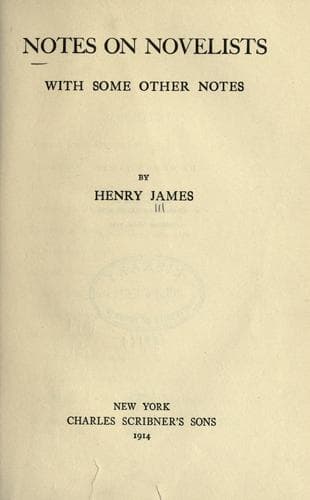
Notes on Novelists, with Some Other NotesJames, Henry
History
Notes on Novelists, with Some Other Notes
James, Henry
Fiction -- History and criticism; Novelists
Just the beauty and the interest of the case are, however, that such a
condition by no means exhausts our opportunity, since in no like
connection could it be less said that to know most is most easily or
most complacently to conclude. May we not decidedly feel the sense and
the “lesson,” the suggestive spread, of a career as a thing scarce
really to be measured when the effect of more and more acquaintance with
it is simply to make the bounds of appreciation recede? This is why the
figure now shown us, blazed upon to the last intensity by the lamplight
of investigation, and with the rank oil consumed in the process fairly
filling the air, declines to let us off from an hour of that
contemplation which yet involves discomfiture for us so long as certain
lucidities on our own part, certain serenities of assurance, fail
correspondingly to play up. We feel ourselves so outfaced, as it were;
we somehow want in any such case to meet and match the assurances with
which the subject himself or herself immitigably bristles, and are
nevertheless by no means certain that our bringing up premature forces
or trying to reply with lights of our own may not check the current of
communication, practically without sense for us unless flowing at its
fullest. At our biographer’s rate of progress we shall still have much
to wait for; but it can meanwhile not be said that we have not plenty to
go on with. To this may be added that the stretch of “life,” apart from
the more concrete exhibition, already accounted for by our three volumes
(if one may discriminate between “production” and life to a degree that
is in this connection exceptionally questionable), represents to all
appearance the most violently and variously agitated face of the career.
The establishment of the Second Empire ushered in for Madame Sand, we
seem in course of preparation to make out, the long period already more
or less known to fame, that is to criticism, as the period of her great
placidity, her more or less notorious appeasement; a string of afternoon
hours as hazily golden as so many reigns of Antonines, when her genius
had mastered the high art of acting without waste, when a happy play of
inspiration had all the air, so far as our spectatorship went, of
filling her large capacity and her beautiful form to the brim, and when
the gathered fruit of what she had dauntlessly done and been heaped
itself upon her table as a rich feast for memory and philosophy. So she
came in for the enjoyment of all the _sagesse_ her contemporaries (with
only such exceptions as M. Paul de Musset and Madame Louise Colet and
the few discordant pleaders for poor Chopin) finally rejoiced on their
side to acclaim; the sum of her aspects “composing,” arranging
themselves in relation to each other, with a felicity that nothing could
exceed and that swept with great glosses and justifications every aspect
of the past. To few has it been given to “pay” so little, according to
Public-domain text, read in full here on John Shaqi.
Reviews
Reviews
No reviews yet
Be the first to share your thoughts on this work.
Elsewhere in the archive
Join the Discussion
Join the discussion
Sign in to leave a comment or review.
Sign InorCreate an account