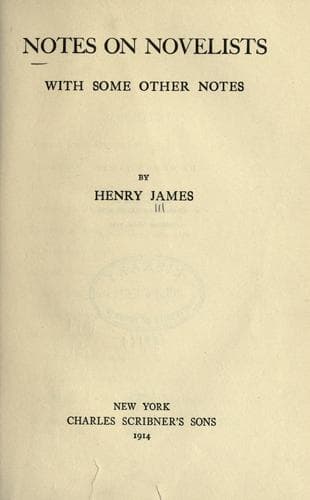
Notes on Novelists, with Some Other NotesJames, Henry
History
Notes on Novelists, with Some Other Notes
James, Henry
Fiction -- History and criticism; Novelists
_our_ superstition of payment, in proportion to such enormities of
ostensibly buying or borrowing—which fact, we have to recognise, left
an existence as far removed either from moral, or intellectual, or even
social bankruptcy as if it had proceeded from the first but on the most
saving lines.
That is what remains on the whole most inimitable in the picture—the
impression it conveys of an art of life by which the rough sense of the
homely adage that we may not both eat our cake and have it was to be
signally falsified; this wondrous mistress of the matter strikes us so
as having consumed _her_ refreshment, her vital supply, to the last
crumb, so far as the provision meant at least freedom and ease, and yet
having ever found on the shelf the luxury in question undiminished.
Superlatively interesting the idea of how this result was, how it
_could_ be, achieved—given the world as we on our side of the water
mainly know it; and it is as meeting the mystery that the monument
before us has doubtless most significance. We shall presently see, in
the light of our renewed occasion, how the question is solved; yet we
may as well at once say that this will have had for its conclusion to
present our heroine—mainly figuring as a novelist of the romantic or
sentimental order once pre-eminent but now of shrunken credit—simply as
a supreme case of the successful practice of life itself. We have to
distinguish for this induction after a fashion in which neither Madame
Sand nor her historian has seemed at all positively concerned to
distinguish; the indifference on the historian’s part sufficiently
indicated, we feel, by the complacency with which, to be thorough, she
explores even the most thankless tracts of her author’s fictional
activity, telling the tales over as she comes to them on much the same
scale on which she unfolds the situations otherwise documented. The
writer of “Consuelo” and “Claudie” and a hundred other things is to this
view a literary genius whose output, as our current term so gracefully
has it, the exercise of an inordinate personal energy happens to mark;
whereas the exercise of personal energy is for ourselves what most
reflects the genius—recorded though this again chances here to be
through the inestimable fact of the possession of style. Of the action
of that perfect, that only real preservative in face of other perils
George Sand is a wondrous example; but her letters alone suffice to show
it, and the style of her letters is no more than the breath of her
nature, her so remarkable one, in which expression and aspiration were
much the same function. That is what it is really to _have_ style—when
you set about performing the act of life. The forms taken by this latter
impulse then cover everything; they serve for your adventures not less
than they may serve at their most refined pitch for your Lélias and your
Mauprats.
Public-domain text, read in full here on John Shaqi.
Reviews
Reviews
No reviews yet
Be the first to share your thoughts on this work.
Elsewhere in the archive
Join the Discussion
Join the discussion
Sign in to leave a comment or review.
Sign InorCreate an account