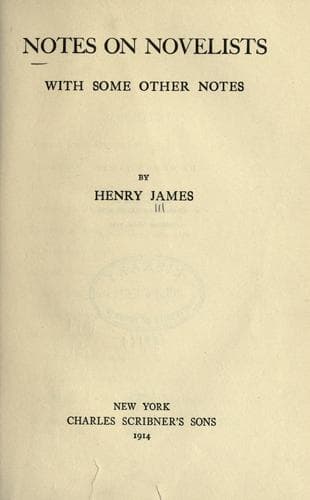
Notes on Novelists, with Some Other NotesJames, Henry
History
Notes on Novelists, with Some Other Notes
James, Henry
Fiction -- History and criticism; Novelists
embark; but they never in the least do them for themselves, themselves
as the “sex,” they do them altogether for men. Nothing could well be
more interesting thus than the extraordinary union of the pair of
opposites in her philosophy of the relation of the sexes—than the
manner in which her immense imagination, the imagination of a man for
range and abundance, intervened in the whole matter for the benefit,
absolutely, of the so-called stronger party, or to liberate her sisters
up to the point at which men may most gain and least lose by the
liberation. She read the relation essentially in the plural term—the
relations, and her last word about these was as far as possible from
being that they are of minor importance to women. Nothing in her view
could exceed their importance to women—it left every other far behind
it; and nothing that could make for authority in her, no pitch of tone,
no range of personal inquiry nor wealth of experience, no acquaintance
with the question that might derive light from free and repeated
adventure, but belonged to the business of driving this argument home.
II
Madame Karénine’s third volume is copiously devoted to the period of her
heroine’s intimacy with Chopin and to the events surrounding this
agitated friendship, which largely fill the ten years precedent to ’48.
Our author is on all this ground overwhelmingly documented, and enlisted
though she is in the service of the more successful party to the
association—in the sense of Madame Sand’s having heartily outlived and
survived, not to say professionally and brilliantly “used,” it—the
great composer’s side of the story receives her conscientious attention.
Curious and interesting in many ways, these reflections of George Sand’s
middle life afford above all the most pointed illustration of the turn
of her personal genius, her aptitude for dealing with men, in the
intimate relation, exactly after the fashion in which numberless
celebrated men have contributed to their reputation, not to say crowned
their claim to superiority, by dealing with women. This being above all
the note of her career, with its vivid show of what such dealing could
mean for play of mind, for quickening of gift, for general experience
and, as we say, intellectual development, for determination of
philosophic bent and education of character and fertilisation of fancy,
we seem to catch the whole process in the fact, under the light here
supplied us, as we catch it nowhere else. It gives us in this
application endlessly much to consider—it is in itself so replete and
rounded a show; we at once recognise moreover how comparatively little
it matters that such works as “Lucrezia Floriani” and “Un Hiver à
Majorque” should have proceeded from it, cast into the shade as these
are, on our biographer’s evidence, by a picture of concomitant energies
still more attaching. It is not here by the force of her gift for rich
Public-domain text, read in full here on John Shaqi.
Reviews
Reviews
No reviews yet
Be the first to share your thoughts on this work.
Elsewhere in the archive
Join the Discussion
Join the discussion
Sign in to leave a comment or review.
Sign InorCreate an account