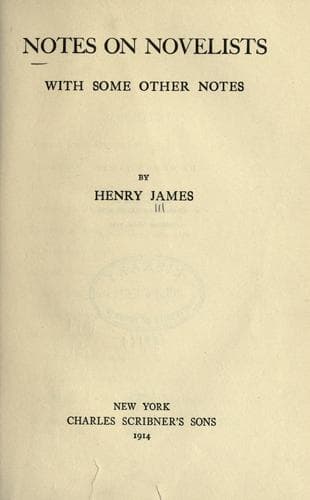
Notes on Novelists, with Some Other NotesJames, Henry
History
Notes on Novelists, with Some Other Notes
James, Henry
Fiction -- History and criticism; Novelists
We are in presence already of a practical shrinkage of
the distinctive, at the rapidest rate, and that it must shrink till
nothing of it worth mentioning be left, what is this but a war-cry
(presenting itself also indeed as a plea for peace) with which our ears
are familiar? Unless the suppression of the distinctive, however, is to
work to the prejudice, as we may fairly call it, of men, drawing them
over to the feminine type rather than drawing women over to
theirs—which is not what seems most probable—the course of the
business will be a virtual undertaking on the part of the half of
humanity acting ostensibly for the first time in freedom to annex the
male identity, that of the other half, so far as may be at all
contrivable, to its own cluster of elements. Individuals are in great
world and race movements negligible, and if that undertaking must
inevitably appeal to different recruits with a differing cogency, its
really enlisting its army or becoming reflected, to a perfectly
conceivable vividness, in the mass, is all our demonstration requires.
At that point begins the revolution, the shift of the emphasis from the
idea of woman’s weakness to the idea of her strength—which is where the
emphasis has lain, from far back, by his every tradition, on behalf of
man; and George Sand’s great value, as we say, is that she gives us the
vision, gives us the particular case, of the shift achieved, displayed
with every assurance and working with every success.
The answer of her life to the question of what an effective annexation
of the male identity may amount to, amount to in favouring conditions
certainly, but in conditions susceptible to the highest degree of
encouragement and cultivation, leaves nothing to be desired for
completeness. This is the moral of her tale, the beauty of what she does
for us—that at no point whatever of her history or her character do
their power thus to give satisfaction break down; so that what we in
fact on the whole most recognise is not the extension she gives to the
feminine nature, but the richness that she adds to the masculine. It is
not simply that she could don a disguise that gaped at the seams, that
she could figure as a man of the mere carnival or pantomime variety, but
that she made so virile, so efficient and homogeneous a one. Admirable
child of the old order as we find her, she was far from our late-coming
theories and fevers—by the reason simply of her not being reduced to
them; as to which nothing about her is more eloquent than her living at
such ease with a conception of the main relevance of women that is
viewed among ourselves as antiquated to “quaintness.” She could afford
the traditional and sentimental, the old romantic and historic theory of
the function most natural to them, since she entertained it exactly as a
man would. It is not that she fails again and again to represent her
heroines as doing the most unconventional things—upon these they freely
Public-domain text, read in full here on John Shaqi.
Reviews
Reviews
No reviews yet
Be the first to share your thoughts on this work.
Elsewhere in the archive
Join the Discussion
Join the discussion
Sign in to leave a comment or review.
Sign InorCreate an account