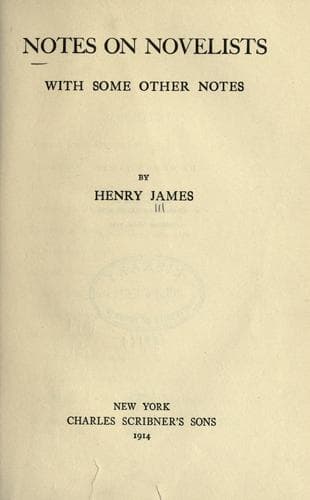
Notes on Novelists, with Some Other NotesJames, Henry
History
Notes on Novelists, with Some Other Notes
James, Henry
Fiction -- History and criticism; Novelists
This biographer, I must of course note, discriminates with delicacy
among her heroine’s felicities and mistakes, recognising that some of
the former, as a latent awkwardness in them developed, inevitably parted
with the signs that distinguished them from the latter; but I think we
feel, as the instances multiply, that no regret could have equalled for
us that of our not having the display vivid and complete. Once all the
elements of the scarce in advance imaginable were there it would have
been a pity that they should not offer us the show of their full
fruition. What more striking show, for example, than that, as recorded
by Madame Karénine in a footnote, the afflicted parent of Solange should
have lived to reproduce, or rather, as she would herself have said, to
“arrange” the girlish character and conduct of that young person, so
humiliating at the time to any near relation, let alone a mother, in the
novel of “Mademoiselle Merquem,” where the truth to the original facts
and the emulation of the graceless prime “effects” are such as our
author can vouch for? The fiction we name followed indeed after long
years, but during the lifetime of the displeasing daughter and with an
ease of reference to the past that may fairly strike us as the last word
of superiority to blighting association. It is quite as if the close and
amused matching of the character and its play in the novel with the
wretched old realities, those that had broken in their day upon the
scared maternal vision, had been a work of ingenuity attended with no
pang. The example is interesting as a measure of the possible victory of
time in a case where we might have supposed the one escape to have been
by forgetting. Madame Sand remembers to the point of
gratefully—gratefully as an artist—reconstituting; we in fact feel
her, as the irrepressible, the “healthy” artist, positively to enjoy so
doing. Thus it clearly defined itself for her in the fulness of time
that, humiliating, to use our expression, as the dreadful Solange might
have been and have incessantly remained, she herself had never in the
least consented to the stupidity or sterility of humiliation. So it
could be that the free mind and the free hand were ever at her service.
A beautiful indifferent agility, a power to cast out that was at least
proportioned to the power to take in, hangs about all this and meets us
in twenty connections. Who of her readers has forgotten the harmonious
dedication—her inveterate dedications have always, like her clear light
prefaces, the last grace—of “Jeanne,” so anciently, so romantically
readable, to her faithful Berrichon servant who sits spinning by the
fire? “Vous ne savez pas lire, ma paisible amie,” but that was not to
prevent the association of her name with the book, since both her own
daughter and the author’s are in happy possession of the art and will be
able to pass the entertainment on to her. This in itself is no more than
Public-domain text, read in full here on John Shaqi.
Reviews
Reviews
No reviews yet
Be the first to share your thoughts on this work.
Elsewhere in the archive
Join the Discussion
Join the discussion
Sign in to leave a comment or review.
Sign InorCreate an account