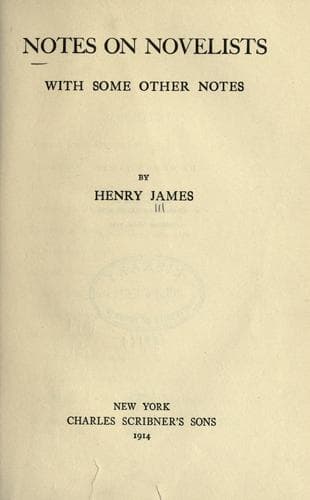
Notes on Novelists, with Some Other NotesJames, Henry
History
Notes on Novelists, with Some Other Notes
James, Henry
Fiction -- History and criticism; Novelists
a sign of the writer’s fine democratic ease, which she carried at all
times to all lengths, and of her charming habit of speech; but it
somehow becomes further illustrational, testifying for the manner in
which genius, if it be but great enough, lives its life at small cost,
when we learn that after all, by a turn of the hand, the “paisible amie”
was, under provocation, bundled out of the house as if the beautiful
relation had not meant half of what appeared. Françoise and her presence
were dispensed with, but the exquisite lines remain, which we would not
be without for the world.
III
The various situations determined for the more eminent of George Sand’s
intimate associates would always be independently interesting, thanks to
the intrinsic appeal of these characters and even without the light
reflected withal on the great agent herself; which is why poor Chopin’s
figuration in the events of the year 1847, as Madame Karénine so fully
reconstitutes them, is all that is wanted to point their almost
nightmare quality. Without something of a close view of them we fail of
a grasp of our heroine’s genius—her genius for keeping her head in deep
seas morally and reflectively above water, though but a glance at them
must suffice us for averting this loss. The old-world quality of drama,
which throughout so thickens and tones the air around her, finds
remarkable expression in the whole picture of the moment. Every
connection involved bristles like a conscious consequence, tells for all
it is worth, as we say, and the sinister complexity of reference—for
all the golden clearings-up that awaited it on the ideal plane—leaves
nothing to be desired. The great and odd sign of the complications and
convulsions, the alarms and excursions recorded, is that these are all
the more or less direct fruits of sensibility, which had primarily been
indulged in, under the doom of a preparation of them which no
preparation of anything else was to emulate, with a good faith fairly
touching in presence of the eventual ugliness. Madame Sand’s wonderful
mother, commemorated for us in “L’Histoire de ma Vie” with the truth
surely attaching in a like degree to no mother in all the literature of
so-called confession, had had for cousin a “fille entretenue” who had
married a mechanic. This Adèle Brault had had in the course of her
adventures a daughter in whom, as an unfortunate young relative, Madame
Dupin had taken an interest, introducing her to the heiress of Nohant,
who viewed her with favour—she appears to have been amiable and
commendable—and eventually associated her with her own children. She
was thus the third member of that illegitimate progeny with which the
Nohant scene was to have become familiar, George Sand’s natural brother
on her father’s side and her natural sister on her mother’s representing
this element from the earlier time on. The young Augustine, fugitive
Public-domain text, read in full here on John Shaqi.
Reviews
Reviews
No reviews yet
Be the first to share your thoughts on this work.
Elsewhere in the archive
Join the Discussion
Join the discussion
Sign in to leave a comment or review.
Sign InorCreate an account