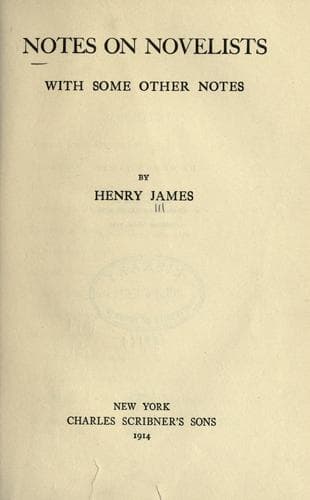
Notes on Novelists, with Some Other NotesJames, Henry
History
Notes on Novelists, with Some Other Notes
James, Henry
Fiction -- History and criticism; Novelists
cause. “Once married,” says Madame Karénine, “she made a double use of
this wickedness. She had always hated Augustine; she wished, one doesn’t
know why, to break off her marriage, and by calumnies and insinuations
she succeeded. Then angry with her mother she avenged herself on her as
well by further calumnies. Thereupon took place at Nohant such events
that”—that in fine we stop before them with this preliminary shudder.
The cross-currents of violence among them would take more keeping apart
than we have time for, the more that everything comes back, for
interest, to the intrinsic weight of the tone of the principal sufferer
from them—as we see her, as we wouldn’t for the world not see her, in
spite of the fact that Chopin was to succumb scarce more than a year
later to multiplied lacerations, and that she was to override and
reproduce and pre-appointedly flourish for long years after. If it is
interesting, as I have pronounced it, that Chopin, again, should have
consented to be of the opinion of Solange that the relations between her
brother Maurice and the hapless Augustine were of the last impropriety,
I fear I can account no better for this than by our sense that the more
the _genius loci_ has to feed her full tone the more our faith in it, as
such a fine thing in itself, is justified. Almost immediately after the
precipitated marriage of the daughter of the house has taken place, the
Clésinger couple, avid and insolent, of a breadth of old time impudence
in fact of which our paler day has lost the pattern, are back on the
mother’s hands, to the effect of a vividest picture of Maurice well-nigh
in a death-grapple with his apparently quite monstrous “bounder” of a
brother-in-law, a picture that further gives us Madame Sand herself
smiting Clésinger in the face and receiving from him a blow in the
breast, while Solange “coldly,” with an iciness indeed peculiarly her
own, fans the rage and approves her husband’s assault, and while the
divine composer, though for that moment much in the background, approves
the wondrous approval. He still approves, to all appearance, the
daughter’s interpretation of the mother’s wish to “get rid” of him as
the result of an amorous design on the latter’s part in respect of a
young man lately introduced to the circle as Maurice’s friend and for
the intimate relation with whom it is thus desirable that the coast
shall be made clear. How else than through no fewer consistencies of the
unedifying on the part of these provokers of the expressional reaction
should we have come by innumerable fine epistolary passages, passages
constituting in themselves verily such adornments of the tale, such
notes in the scale of all the damaged dignity redressed, that we should
be morally the poorer without them? One of the vividest glimpses indeed
is not in a letter but in a few lines from “L’Histoire de ma Vie,” the
composition of which was begun toward the end of this period and while
Public-domain text, read in full here on John Shaqi.
Reviews
Reviews
No reviews yet
Be the first to share your thoughts on this work.
Elsewhere in the archive
Join the Discussion
Join the discussion
Sign in to leave a comment or review.
Sign InorCreate an account