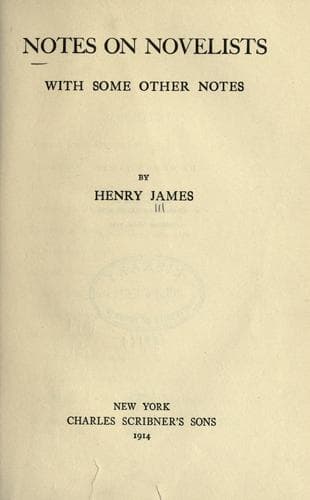
Notes on Novelists, with Some Other NotesJames, Henry
History
Notes on Novelists, with Some Other Notes
James, Henry
Fiction -- History and criticism; Novelists
also one of the wretchedest, but the oddity makes it interesting, by the
law I just glanced at, in spite of its vulgar side. How could it not be
interesting, we ask as we read, to feel that Chopin, though far from the
one man, was the one gentleman of the association, the finest set of
nerves and scruples, and yet to see how little that availed him, in
exasperated reactions, against mistakes of perverted sympathy? It is
relevant in a high degree to our view of his great protectress as
reducible at her best to male terms that she herself in this very light
fell short, missed the ideal safeguard which for her friend had been
preinvolved—as of course may be the peril, ever, with the creature so
transmuted, and as is so strikingly exemplified, in the pages before us,
when Madame Karénine ingenuously gives us chapter and verse for her
heroine’s so unqualified demolition of the person of Madame d’Agoult,
devotee of Liszt, mother to be, by that token, of Richard Wagner’s
second wife, and sometime intimate of the author of “Isidora,” in which
fiction we are shown the parody perpetrated. If women rend each other on
occasion with sharper talons than seem to belong on the whole to the
male hand, however intendingly applied, we find ourselves reflect
parenthetically that the loss of this advantage may well be a matter for
them to consider when the new approximation is the issue.
The great sign of the Nohant circle on all this showing, at any rate, is
the intense personalism, as we may call it, reigning there, or in other
words the vivacity, the acuity and irritability of the personal
relations—which flourished so largely, we at the same time feel, by
reason of the general gift for expression, that gift to which we owe the
general superiority of every letter, from it scarce matters whom, laid
under contribution by our author. How could people not feel with acuity
when they could, when they had to, write with such point and such
specific intelligence?—just indeed as one asks how letters could fail
to remain at such a level among them when they incessantly generated
choice matter for expression. Madame Sand herself is of course on this
ground easily the most admirable, as we have seen; but every one “knows
how” to write, and does it well in proportion as the matter in hand most
demands and most rewards proper saying. Much of all this stuff of
history seems indeed to have been susceptible of any amount of force of
statement; yet we note all the while how in the case of the great
mistress of the pen at least some shade of intrinsic beauty attends even
the presentation of quite abominable facts. We can only see it as
abominable, at least, so long as we have Madame Sand’s words—which are
somehow a different thing from her word—for it, that Chopin had from
the first “sided” with the atrocious Solange in that play of her genius
which is characterised by our chronicler as wickedness for the sake of
wickedness, as art for the sake of art, without other logic or other
Public-domain text, read in full here on John Shaqi.
Reviews
Reviews
No reviews yet
Be the first to share your thoughts on this work.
Elsewhere in the archive
Join the Discussion
Join the discussion
Sign in to leave a comment or review.
Sign InorCreate an account