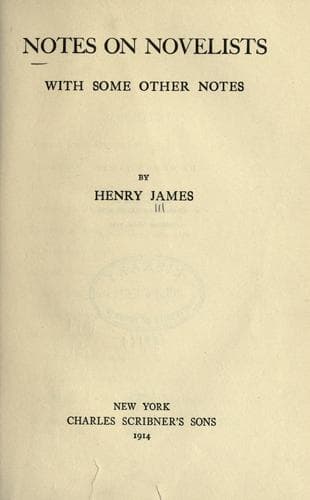
Notes on Novelists, with Some Other NotesJames, Henry
History
Notes on Novelists, with Some Other Notes
James, Henry
Fiction -- History and criticism; Novelists
This is a yearning, however, that Signor D’Annunzio may at last strike
us as supremely formed to gratify; so promptly we find in him as a
literary figure the highest expression of the reality that our own
conditions were to fail of making possible. He has immediately the value
of giving us by his mere logical unfolding the measure of our
shortcomings in the same direction, that of our timidities and penuries
and failures. He throws a straighter and more inevitable light on the
esthetic consciousness than has, to my sense, in our time, reached it
from any other quarter; and there is many a mystery that properly
interrogated he may help to clear up for us, many an explanation of our
misadventure that—as I have glanced at it—he may give. He starts with
the immense advantage of enjoying the invoked boon by grace and not by
effort, of claiming it under another title than the sweat of his brow
and the aspiration of his culture. He testifies to the influence of
things that have had time to get themselves taken for granted. Beauty at
any price is an old story to him; art and form and style as the aim of
the superior life are a matter of course; and it may be said of him, I
think, that, thanks to these transmitted and implanted instincts and
aptitudes, his individual development begins where the struggle of the
mere earnest questioner ends. Signor D’Annunzio is earnest in his way,
quite extraordinarily—which is a feature of his physiognomy that we
shall presently come to and about which there will be something to say;
but we feel him all the while in such secure possession of his heritage
of favouring circumstance that his sense of intellectual responsibility
is almost out of proportion. This is one of his interesting special
marks, the manner in which the play of the esthetic instinct in him
takes on, for positive extravagance and as a last refinement of freedom,
the crown of solicitude and anxiety. Such things but make with him for
ornament and parade; they are his tribute to civility; the essence of
the matter is meanwhile in his blood and his bones. No mistake was
possible from the first as to his being of the inner literary camp—a
new form altogether of perceptive and expressive energy; the question
was settled by the intensity and variety, to say nothing of the
precocity, of his early poetic production.
Public-domain text, read in full here on John Shaqi.
Reviews
Reviews
No reviews yet
Be the first to share your thoughts on this work.
Elsewhere in the archive
Join the Discussion
Join the discussion
Sign in to leave a comment or review.
Sign InorCreate an account