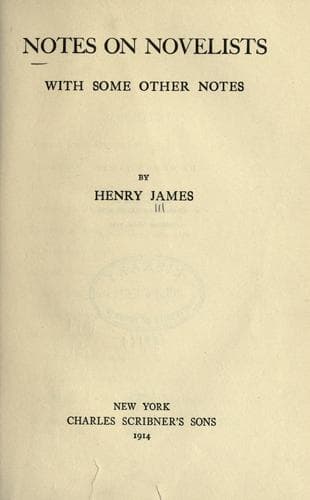
Notes on Novelists, with Some Other NotesJames, Henry
History
Notes on Novelists, with Some Other Notes
James, Henry
Fiction -- History and criticism; Novelists
Born at Pescara, in the Regno, the old kingdom of Naples, “toward” 1863,
as I find noted by a cautious biographer, he had while scarce out of his
teens allowed his lyric genius full opportunity of scandalising even the
moderately austere. He defined himself betimes very much as he was to
remain, a rare imagination, a poetic, an artistic intelligence of
extraordinary range and fineness concentrated almost wholly on the life
of the senses. For the critic who simplifies a little to state clearly,
the only ideas he urges upon us are the erotic and the plastic, which
have for him about an equal intensity, or of which it would be doubtless
more correct to say that he makes them interchangeable faces of the same
figure. He began his career by playing with them together in verse, to
innumerable light tunes and with an extraordinary general effect of
curiosity and brilliancy. He has continued still more strikingly to play
with them in prose; they have remained the substance of his intellectual
furniture. It is of his prose only, however, that, leaving aside the
Intermezzo, L’Isottèo, La Chimera, Odi Navali and other such matters, I
propose to speak, the subject being of itself ample for one occasion.
His five novels and his four plays have extended his fame; they suggest
by themselves as many observations as we shall have space for. The group
of productions, as the literary industry proceeds among us to-day, is
not large, but we may doubt if a talent and a temperament, if indeed a
whole “view of life,” ever built themselves up as vividly for the reader
out of so few blocks. The writer is even yet enviably young; but this
solidity of his literary image, as of something already seated on time
and accumulation, makes him a rare example. Precocity is somehow an
inadequate name for it, as precocity seldom gets away from the element
of promise, and it is not exactly promise that blooms in the hard
maturity of such a performance as “The Triumph of Death.” There are
certain expressions of experience, of the experience of the whole man,
that are like final milestones, milestones for his possible fertility if
not for his possible dexterity; a truth that has not indeed prevented
“Il Fuoco,” with its doubtless still ampler finality, from following the
work just mentioned. And we have had particularly before us, in verse, I
must add, “Francesca da Rimini,” with the great impression a great
actress has enabled this drama to make.
Public-domain text, read in full here on John Shaqi.
Reviews
Reviews
No reviews yet
Be the first to share your thoughts on this work.
Elsewhere in the archive
Join the Discussion
Join the discussion
Sign in to leave a comment or review.
Sign InorCreate an account