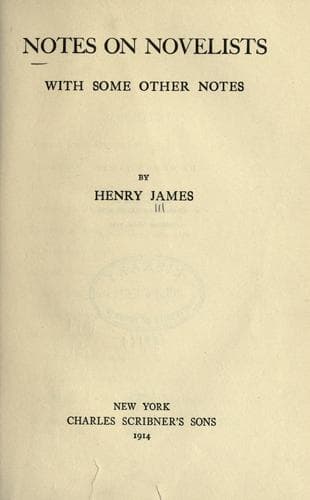
Notes on Novelists, with Some Other NotesJames, Henry
History
Notes on Novelists, with Some Other Notes
James, Henry
Fiction -- History and criticism; Novelists
Nothing could be more characteristic of the writer than the way what has
preceded flowers into that last reality; and equally in his best manner,
doubtless, is such a passage as the following from the same volume,
which treats of the hero’s first visit to the sinister great lady whose
influence on his soul and his senses is to become as the trail of a
serpent. She receives him, after their first accidental meeting, with
extraordinary promptitude and the last intimacy, receives him in the
depths of a great Roman palace which the author, with a failure of taste
that is, unfortunately for him, on ground of this sort, systematic,
makes a point of naming. “Then they ceased to speak. Each felt the
presence of the other flow and mingle with his own, with her own, very
blood; till it was _her_ blood at last that seemed to have become his
life, and his that seemed to have become hers. The room grew larger in
the deep silence; the crucifix of Guido Reni made the shade of the
canopy and curtains religious; the rumour of the city came to them like
the murmur of some far-away flood.” Or take for an instance of the
writer’s way of showing the consciousness as a full, mixed cup, of
touching us ourselves with the mystery at work in his characters, the
description of the young man’s leaving the princely apartments in
question after the initiation vouchsafed to him. He has found the great
lady ill in bed, with remedies and medicine-bottles at her side, but not
too ill, as we have seen, to make him welcome. “Farewell,” she has said.
“Love me! Remember!”
It seemed to him, crossing the threshold again, that he heard
behind him a burst of sobs. But he went on, a little uncertain,
wavering like a man who sees imperfectly. The odour of the
chloroform clung to his sense like some fume of intoxication;
but at each step something intimate passed away from him,
wasting itself in the air, so that, impulsively, instinctively,
he would have kept himself as he was, have closed himself in,
have wrapped himself up to prevent the dispersion. The rooms in
front of him were deserted and dumb. At one of the doors
“Mademoiselle” appeared, with no sound of steps, with no rustle
of skirts, standing there like a ghost. “This way, signor conte.
You won’t find it.” She had an ambiguous, irritating smile, and
her curiosity made her grey eyes more piercing. Andrea said
nothing. The woman’s presence again disconcerted and troubled
him, affected him with a vague repugnance, stirred indeed his
wrath.
Public-domain text, read in full here on John Shaqi.
Reviews
Reviews
No reviews yet
Be the first to share your thoughts on this work.
Elsewhere in the archive
Join the Discussion
Join the discussion
Sign in to leave a comment or review.
Sign InorCreate an account