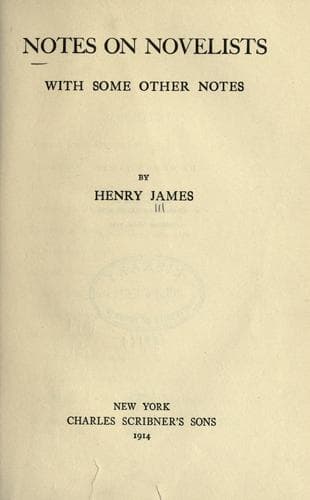
Notes on Novelists, with Some Other NotesJames, Henry
History
Notes on Novelists, with Some Other Notes
James, Henry
Fiction -- History and criticism; Novelists
“His will”—of the hero’s
weakness—“useless as a sword of base temper hung at the side of a
drunkard or a dullard.” Or of his own southern land in September: “I
scarce know why, looking at the country in this season, I always think
of some beautiful woman after childbirth, who lies back in her white
bed, smiling with a pale astonished inextinguishable smile.” Or the
incision of this: “Where for him now were those unclean short-lived
loves that left in the mouth the strange acidity of fruit cut with a
steel knife?” Or the felicity of the following, of a southern night seen
and felt from the terrace of a villa. “Clear meteors at intervals
streaked the motionless air, running over it as lightly and silently as
drops of water on a crystal pane.” “The sails on the sea,” he says of
the same look-out by day, “were as pious and numberless as the wings of
cherubim on the gold grounds of old Giottesque panels.”
But it is above all here for two things that his faculty is admirable;
one of them his making us feel through the windows of his situation, or
the gaps, as it were, of his flowering wood, the golden presence of
Rome, the charm that appeals to him as if he were one of the pilgrims
from afar, save that he reproduces it with an authority in which, as we
have seen, the pilgrims from afar have mainly been deficient. The other
is the whole category of the phenomena of “passion,” as passion prevails
between his men and his women—and scarcely anything else prevails; the
states of feeling, of ecstasy and suffering engendered, the play of
sensibility from end to end of the scale. In this direction he has left
no dropped stitches for any worker of like tapestries to pick up. We
shall here have made out that many of his “values” are much to be
contested, but that where they are true they are as fresh as
discoveries; witness the passage where Sperelli, driving back to Rome
after a steeplechase in which he has been at the supreme moment worsted,
meets nothing that does not play with significance into his vision and
act with force on his nerves. He has before the race had “words,” almost
blows, on the subject of one of the ladies present, with one of the
other riders, of which the result is that they are to send each other
their seconds; but the omens are not for his adversary, in spite of the
latter’s success on the course.
From the mail-coach, on the return, he overtook the flight
toward Rome of Giannetto Rutolo, seated in a small two-wheeled
trap, behind the quick trot of a great roan, over whom he bent
with tight reins, holding his head down and his cigar in his
teeth, heedless of the attempts of policemen to keep him in
line. Rome, in the distance, stood up dark against a zone of
light as yellow as sulphur; and the statues crowning St. John
Lateran looked huge, above the zone, in their violet sky. _Then
it was that Andrea fully knew the pain he was making another
soul suffer._
Public-domain text, read in full here on John Shaqi.
Reviews
Reviews
No reviews yet
Be the first to share your thoughts on this work.
Elsewhere in the archive
Join the Discussion
Join the discussion
Sign in to leave a comment or review.
Sign InorCreate an account