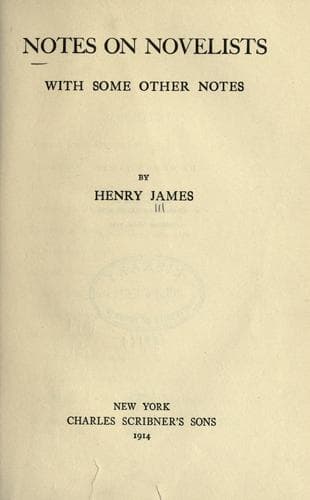
Notes on Novelists, with Some Other NotesJames, Henry
History
Notes on Novelists, with Some Other Notes
James, Henry
Fiction -- History and criticism; Novelists
It is one of the miracles of the imagination; the great shining element
in which the characters flounder and suffer becomes rich and beautiful
for them, as well as in so many ways for us, by the action of the
writer’s mind. They not only live in his imagination, but they borrow it
from him in quantities; indeed without this charitable advance they
would be poor creatures enough, for they have in each case almost
nothing of their own. On the aid thus received they start, they get into
motion; it makes their common basis of “passion,” desire, enchantment,
aversion. The essence of the situation is the same in “Il Trionfo” and
“Il Fuoco” as in “L’Innocente”: the temporarily united pair devour each
other, tear and rend each other, wear each other out through a series of
erotic convulsions and nervous reactions that are made
interesting—interesting to _us_—almost exclusively by the special
wealth of their consciousness. The medium in which they move is
admirably reflected in it; the autumn light of Venice, the afterglow of
her past, in the drama of the elderly actress and the young rhetorician
of “Il Fuoco”; the splendour of the summer by the edge of the lower
Adriatic in that of the two isolated erotomaniacs of “Il Trionfo,”
indissolubly linked at last in the fury of physical destruction into
which the man drags the woman by way of retribution for the fury of
physical surrender into which she has beguiled him.
As for “L’Innocente” again, briefly, there is perhaps nothing in it to
match the Roman passages of “Il Piacere”; but the harmony of the
general, the outer conditions pervades the picture; the sweetness of the
villeggiatura life, the happiness of place and air, the lovability of
the enclosing scene, all at variance with the sharpness of the inner
tragedy. The inner tragedy of “L’Innocente” has a concentration that is
like the carrying, through turns and twists, upstairs and down, of some
cup filled to the brim, of which no drop is yet spilled; such cumulative
truth rules the scene after we have once accepted the postulate. It is
true that the situation as exhibited involves for Giuliana, the young
wife, the vulgarest of adventures; yet she becomes, as it unfolds, the
figure of the whole gallery in whom the pathetic has at once most of
immediate truth and of investing poetry. I much prefer her for beauty
and interest to Donna Maria in “Il Piacere,” the principal other image
of faith and patience sacrificed. We see these virtues as still supreme
in her even while she faces, in advance, her ordeal, in respect to which
it has been her hope, in fact her calculation, that her husband will
have been deceived about the paternity of her child; and she is so
truthfully touching when this possibility breaks down that even though
we rub our eyes at the kind of dignity claimed for her we participate
without reserve in her predicament. The origin of the infant is frankly
ignoble, whereas it is on the nobleness of Giuliana that the story
Public-domain text, read in full here on John Shaqi.
Reviews
Reviews
No reviews yet
Be the first to share your thoughts on this work.
Elsewhere in the archive
Join the Discussion
Join the discussion
Sign in to leave a comment or review.
Sign InorCreate an account