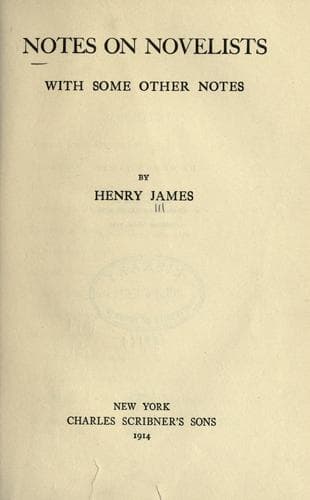
Notes on Novelists, with Some Other NotesJames, Henry
History
Notes on Novelists, with Some Other Notes
James, Henry
Fiction -- History and criticism; Novelists
essentially hinges; but the contradiction is wonderfully kept from
disconcerting us altogether. What the author has needed for his
strangest truth is that the mother shall feel exactly as the husband
does, and that the husband shall after the first shock of his horror
feel intimately and explicitly with the mother. They take in this way
the same view of their woeful excrescence; and the drama of the child’s
advent and of the first months of his existence, his insistent and hated
survival, becomes for them in respect to the rest of the world a drama
of silence and dissimulation, in every step of which we feel a terror.
The effect, I may add, gains more than one kind of intensity from that
almost complete absence of _other_ contacts to which D’Annunzio
systematically condemns his creatures; introducing here, however, just
the two or three that more completely mark the isolation. It may
doubtless be conceded that our English-speaking failure of insistence,
of inquiry and penetration, in certain directions, springs partly from
our deep-rooted habit of dealing with man, dramatically, on his social
and gregarious side, as a being the variety of whose intercourse with
his fellows, whatever forms his fellows may take, is positively half his
interesting motion. We fear to isolate him, for we remember that as we
see and know him he scarce understands himself save in action, action
which inevitably mixes him with his kind. To see and know him, like
Signor D’Annunzio, almost only in passion is another matter, for passion
spends itself quickly in the open and burns hot mainly in nooks and
corners. Nothing, too, in the picture is more striking than the manner
in which the merely sentimental abyss—that of the couple brought
together by the thing that might utterly have severed them—is
consistently and successfully avoided. We should have been certain to
feel it in many other hands yawning but a few steps off. We see the
dreadful facts in themselves, are brought close to them with no
interposing vaguenesses or other beggings of the question, and are
forcibly reminded how much more this “crudity” makes for the
communication of tenderness—what is aimed at—than an attitude
conventionally more reticent. We feel what the tenderness can be when it
rests on _all_ the items of a constituted misery, not one of which is
illogically blinked.
Public-domain text, read in full here on John Shaqi.
Reviews
Reviews
No reviews yet
Be the first to share your thoughts on this work.
Elsewhere in the archive
Join the Discussion
Join the discussion
Sign in to leave a comment or review.
Sign InorCreate an account