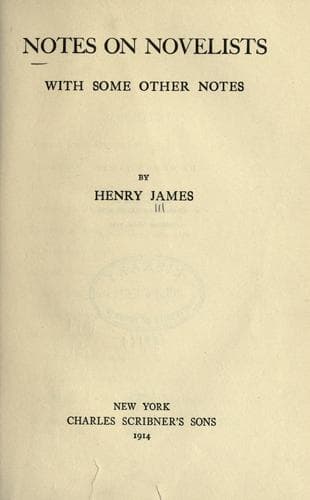
Notes on Novelists, with Some Other NotesJames, Henry
History
Notes on Novelists, with Some Other Notes
James, Henry
Fiction -- History and criticism; Novelists
To these reflections he has been brought by the long, dangerous past
which, as the author says, his connection with his mistress has behind
it—a past of recriminations of which the ghosts still walk. “It dragged
behind it, through time, an immense dark net, all full of dead things.”
To quote here at all is always to desire to continue, and “Il Trionfo”
abounds in the illustrative episodes that are ever made so masterfully
concrete. Offering in strictness, incidentally, the only exhibition in
all the five volumes of a human relation other than the acutely sexual,
it deals admirably enough with this opportunity when the hero pays his
visit to his provincial parents before settling with his mistress at
their hermitage. His people are of ancient race and have been much at
their ease; but the home in the old Apulian town, overdarkened by the
misdeeds of a demoralised father, is on the verge of ruin, and the dull
mean despair of it all, lighted by outbreaks of helpless rage on the
part of the injured mother, is more than the visitor can bear, absorbed
as he is in impatiences and concupiscences which make everything else
cease to exist for him. His terror of the place and its troubles but
exposes of course the abjection of his weakness, and the sordid
squabbles, the general misery and mediocrity of life that he has to
face, constitute precisely, for his personal design, the abhorred
challenge of ugliness, the interference of a call other than erotic. He
flees before it, leaving it to make shift as it can; but nothing could
be more “rendered” in detail than his overwhelmed vision of it.
Public-domain text, read in full here on John Shaqi.
Reviews
Reviews
No reviews yet
Be the first to share your thoughts on this work.
Elsewhere in the archive
Join the Discussion
Join the discussion
Sign in to leave a comment or review.
Sign InorCreate an account