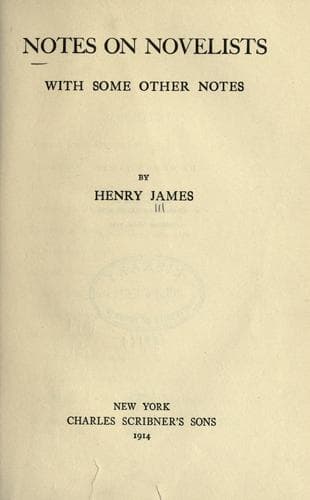
Notes on Novelists, with Some Other NotesJames, Henry
History
Notes on Novelists, with Some Other Notes
James, Henry
Fiction -- History and criticism; Novelists
The mixture reaches its maximum, however, in “Il Fuoco,” if not perhaps
in “The Virgins of the Rocks”; the mixture I mean of every exhibited
element of personal charm, distinction and interest, with every
insidious local influence, every glamour of place, season and
surrounding object. The heroine of the first-named is a great tragic
actress, exquisite for everything but for being unfortunately
middle-aged, battered, marked, as we are constantly reminded, by all the
after-sense of a career of promiscuous carnal connections. The hero is a
man of letters, a poet, a dramatist of infinite reputation and resource,
and their union is steeped to the eyes in the gorgeous medium of Venice,
the moods of whose melancholy and the voices of whose past are an active
part of the perpetual concert. But we see _all_ the persons introduced
to us yearn and strain to exercise their perceptions and taste their
impressions as deeply as possible, conspiring together to interweave
them with the pleasures of passion. They “go in” as the phrase is, for
beauty at any cost—for each other’s own to begin with; their creator,
in the inspiring quest, presses them hard, and the whole effect becomes
for us that of an organised general sacrifice to it and an organised
general repudiation of everything else. It is not idle to repeat that
the value of the Italian background has to this end been inestimable,
and that every spark of poetry it had to contribute has been struck from
it—with what supreme felicity we perhaps most admiringly learn in “The
Virgins of the Rocks.” To measure the assistance thus rendered, and
especially the immense literary lift given, we have only to ask
ourselves what appearance any one of the situations presented would have
made in almost any Cisalpine or “northern” frame of circumstance
whatever. Supported but by such associations of local or of literary
elegance as _our_ comparatively thin resources are able to furnish, the
latent weakness in them all, the rock, as to final effect, on which they
split and of which I shall presently speak, would be immeasurably less
dissimulated. All this is the lesson of style, by which we here catch a
writer in the very act of profiting after a curious double fashion.
D’Annunzio arrives at it both by expression and by material—that is, by
a whole side of the latter; so that with such energy at once and such
good fortune it would be odd indeed if he had not come far. It is verily
in the very name and interest of beauty, of the lovely impression, that
Giorgio Aurispa becomes homicidal in thought and finally in act.
She would in death become for me matter of thought, pure
ideality. From a precarious and imperfect existence she would
enter into an existence complete and definitive, forsaking
forever the infirmity of her weak luxurious flesh. Destroy to
possess—there is no other way for him who seeks the absolute in
love.
Public-domain text, read in full here on John Shaqi.
Reviews
Reviews
No reviews yet
Be the first to share your thoughts on this work.
Elsewhere in the archive
Join the Discussion
Join the discussion
Sign in to leave a comment or review.
Sign InorCreate an account