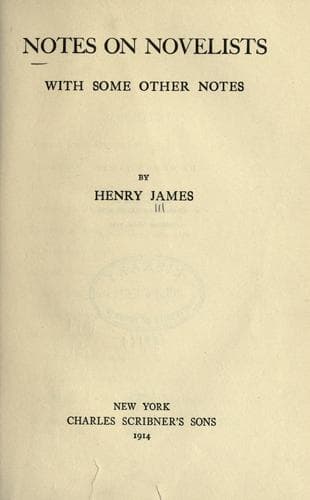
Notes on Novelists, with Some Other NotesJames, Henry
History
Notes on Novelists, with Some Other Notes
James, Henry
Fiction -- History and criticism; Novelists
The wonder-working shrine of the Abruzzi, to which they have previously
made their way, is a local Lourdes, the resort from far and wide of the
physically afflicted, the evocation of whose multitudinous presence, the
description of whose unimaginable miseries and ecstasies, grovelling
struggles and supplications, has the mark of a pictorial energy for such
matters not inferior to that of Émile Zola—to the degree even that the
originality of the pages in question was, if I remember rightly, rather
sharply impugned in Paris. D’Annunzio’s defence, however, was easy,
residing as it does in the fact that to handle any subject successfully
handled by Zola (his failures are another matter) is quite inevitably to
walk more or less in his footsteps, in prints so wide and deep as to
leave little margin for passing round them. To which I may add that,
though the judgment may appear odd, the truth and force of the young
man’s few abject days at Guardiagrele, his _casa paterna_, are such as
to make us wish that other such corners of life were more frequent in
the author’s pages. He has the supremely interesting quality in the
novelist that he _fixes_, as it were, the tone of every cluster of
objects he approaches, fixes it by the consistency and intensity of his
reproduction. In “The Virgins of the Rocks” we have also a _casa
paterna_, and a thing, as I have indicated, of exquisite and wonderful
tone; but the tone here is of poetry, the truth and the force are less
measurable and less familiar, and the whole question, after all, in its
refined and attenuated form, is still that of sexual pursuit, which
keeps it within the writer’s too frequent limits. Giorgio Aurispa, in
“Il Trionfo,” lives in communion with the spirit of an amiable and
melancholy uncle who had committed suicide and made him the heir of his
fortune, and one of the nephew’s most frequent and faithful loyalties is
to hark back, in thought, to the horror of his first knowledge of the
dead man’s act, put before us always with its accompaniment of loud
southern resonance and confusion. He is in the place again, he is in the
room, at Guardiagrele, of the original appalled vision.
Public-domain text, read in full here on John Shaqi.
Reviews
Reviews
No reviews yet
Be the first to share your thoughts on this work.
Elsewhere in the archive
Join the Discussion
Join the discussion
Sign in to leave a comment or review.
Sign InorCreate an account