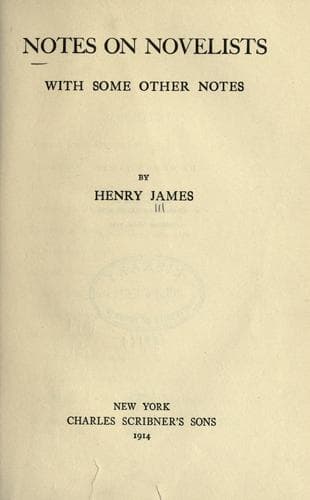
Notes on Novelists, with Some Other NotesJames, Henry
History
Notes on Novelists, with Some Other Notes
James, Henry
Fiction -- History and criticism; Novelists
He heard, in the stillness of the air and of his arrested soul,
the small shrill of an insect in the wainscot. And the little
fact sufficed to dissipate for the moment the extreme violence
of his nervous tension, as the puncture of a needle suffices to
empty a swollen bladder. Every particular of the terrible day
came back to his memory: the news abruptly brought to Torretta
di Sarsa, toward three in the afternoon, by a panting messenger
who stammered and whimpered: the ride on horseback, at lightning
speed, under the canicular sky and up the torrid slopes, and,
during the rush, the sudden faintnesses that turned him dizzy in
his saddle; then the house at home, filled with sobs, filled
with a noise of doors slamming in the general scare, filled with
the strumming of his own arteries; and at last his irruption
into the room, the sight of the corpse, the curtains inflated
and rustling, the tinkle on the wall of the little font for holy
water.
This young man’s great mistake, we are told, had been his insistence on
regarding love as a form of enjoyment. He would have been in a possible
relation to it only if he had learned to deal with it as a form of
suffering. This is the lesson brought home to the heroine of “Il Fuoco,”
who suffers indeed, as it seems to us, so much more than is involved in
the occasion. We ask ourselves continually why; that is we do so at
first; we do so before the special force of the book takes us captive
and reduces us to mere charmed absorption of its successive parts and
indifference to its moral sense. Its defect is verily that it has no
moral sense proportionate to the truth, the constant high style of the
general picture; and this fact makes the whole thing appear given us
simply because it has happened, because it was material that the author
had become possessed of, and not because, in its almost journalistic
“actuality,” it has any large meaning. We get the impression of a direct
transfer, a “lift,” bodily, of something seen and known, something not
really produced by the chemical process of art, the crucible or retort
from which things emerge for a new function. Their meaning here at any
rate, extracted with difficulty, would seem to be that there is an
inevitable leak of ease and peace when a mistress happens to be
considerably older than her lover; but even this interesting yet not
unfamiliar truth loses itself in the great poetic, pathetic, psychologic
ceremonial.
Public-domain text, read in full here on John Shaqi.
Reviews
Reviews
No reviews yet
Be the first to share your thoughts on this work.
Elsewhere in the archive
Join the Discussion
Join the discussion
Sign in to leave a comment or review.
Sign InorCreate an account