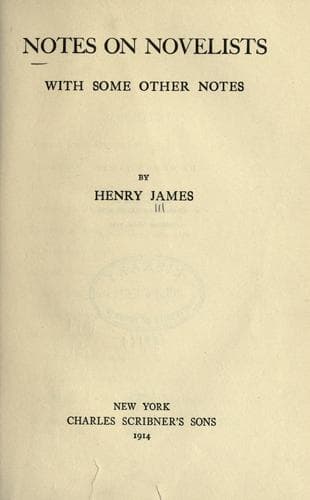
Notes on Novelists, with Some Other NotesJames, Henry
History
Notes on Novelists, with Some Other Notes
James, Henry
Fiction -- History and criticism; Novelists
marked human analogy, inasmuch as if it is interesting to be puzzled to
a certain extent by what an action, placed before us, is designed to
show or to signify, so we require for this refined amusement at least
the sense that some general idea _is_ represented. We must feel it
present.
Therefore if making out nothing very distinct in “Le Vergini” but the
pictorial idea, and yet cleaving to the preference I have expressed, I
let the anomaly pass as a tribute extorted by literary art, I may seem
to imply that a book may have a great interest without showing a perfect
sense. The truth is undoubtedly that I am in some degree beguiled and
bribed by the particularly intense expression given in these pages to
the author’s esthetic faith. If he is so supremely a “case” it is
because this production has so much to say for it, and says it with such
a pride of confidence, with an assurance and an elegance that fairly
make it the last conceivable word of such a profession. The observations
recorded have their origin in the narrator’s passionate reaction against
the vulgarity of the day. All the writer’s young men react; but
Cantelmo, in the volume before us, reacts with the finest contempt. He
is, like his brothers, a _raffiné_ conservative, believing really, so
far as we understand it, only in the virtue of “race” and in the grand
manner. The blighted Virgins, with all that surrounds them, are an
affirmation of the grand manner—that is of the shame and scandal of
what in an odious age it has been reduced to. It consists indeed of a
number of different things which I may not pretend to have completely
fitted together, but which are, with other elements, the sense of the
supremacy of beauty, the supremacy of style and, last not least, of the
personal will, manifested for the most part as a cold insolence of
attitude—not manifested as anything much more edifying. What it really
appears to come to is that the will is a sort of romantic ornament, the
application of which, for life in the present and the future, remains
awkwardly vague, though we are always to remember that it has been
splendidly forged in the past. The will in short _is_ beauty, is style,
is elegance, is art—especially in members of great families and
possessors of large fortunes. That of the hero of “Le Vergini” has been
handed down to him direct, as by a series of testamentary provisions,
from a splendid young ancestor for whose memory and whose portrait he
has a worship, a warrior and virtuoso of the Renaissance, the model of
his spirit.
He represents for me the mysterious meaning of the power of
style, not violable by any one, and least of all ever by myself
in my own person.
And elsewhere:—
Public-domain text, read in full here on John Shaqi.
Reviews
Reviews
No reviews yet
Be the first to share your thoughts on this work.
Elsewhere in the archive
Join the Discussion
Join the discussion
Sign in to leave a comment or review.
Sign InorCreate an account