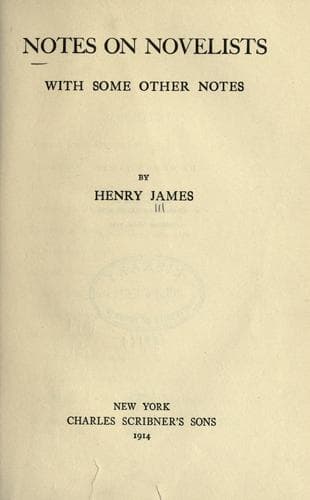
Notes on Novelists, with Some Other NotesJames, Henry
History
Notes on Novelists, with Some Other Notes
James, Henry
Fiction -- History and criticism; Novelists
It would take time to say what we play with in the silver-toned “Virgins
of the Rocks,” the history of a visit paid by a transcendent young
man—always pretty much the same young man—to an illustrious family
whose fortunes have tragically shrunken with the expulsion of the
Bourbons from the kingdom of Naples, and the three last lovely daughters
of whose house are beginning to wither on the stem, undiscovered,
unsought, in a dilapidated old palace, an old garden of neglected pomp,
a place of fountains and colonnades, marble steps and statues, all
circled with hard bright sun-scorched volcanic scenery. They are tacitly
candidates for the honour of the hero’s hand, and the subject of the
little tale, which deals with scarce more than a few summer days, is the
manner of their presenting themselves for his admiration and his choice.
I decidedly name this exquisite composition as my preferred of the
series; for if its tone is thoroughly romantic the romance is yet of the
happiest kind, the kind that consists in the imaginative development of
observable things, things present, significant, related to us, and not
in a weak false fumble for the remote and the disconnected.
It is indeed the romantic mind itself that makes the picture, and there
could be no better case of the absolute artistic vision. The mere facts
are soon said; the main fact, above all, of the feeble remnant of an
exhausted race waiting in impotence to see itself cease to be. The
father has nothing personal left but the ruins of his fine presence and
of his old superstitions, a handful of silver dust; the mother, mad and
under supervision, stalks about with the delusion of imperial greatness
(there is a wonderful page on her parading through the gardens in her
rococo palanquin, like a Byzantine empress, attended by sordid keepers,
while the others are hushed into pity and awe); the two sons,
hereditarily tainted, are virtually imbecile; the three daughters,
candidly considered, are what we should regard in our Anglo-Saxon world
as but the stuff of rather particularly dreary and shabby, quite
unutterably idle old maids. Nothing, within the picture, occurs; nothing
is done or, more acutely than usual, than everywhere, suffered; it is
all a mere affair of the rich impression, the complexity of images
projected upon the quintessential spirit of the hero, whose own report
is what we have—an affair of the quality of observation, sentiment and
eloquence brought to bear. It is not too much to say even that the whole
thing is in the largest sense but a theme for style, style of substance
as well as of form. Within this compass it blooms and quivers and
shimmers with light, becomes a wonderful little walled garden of
romance. The young man has a passage of extreme but respectful
tenderness with each of the sisters in turn, and the general cumulative
effect is scarcely impaired by the fact that “nothing comes” of any of
these relations. Too little comes of anything, I think, for any very
Public-domain text, read in full here on John Shaqi.
Reviews
Reviews
No reviews yet
Be the first to share your thoughts on this work.
Elsewhere in the archive
Join the Discussion
Join the discussion
Sign in to leave a comment or review.
Sign InorCreate an account