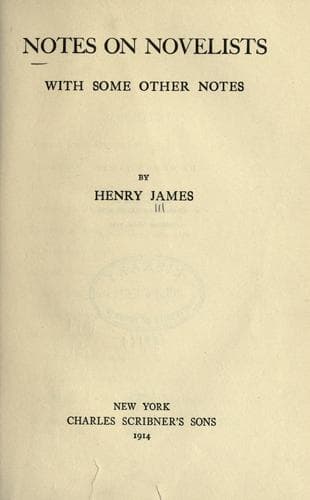
Notes on Novelists, with Some Other NotesJames, Henry
History
Notes on Novelists, with Some Other Notes
James, Henry
Fiction -- History and criticism; Novelists
The interest then springs from its being involved for us in the “case.”
We recognise so many suggested consequences if the case is really to
prove responsible for it. We ask ourselves if there be not a connection,
we almost tremble lest there shouldn’t be; since what is more obvious
than that, if a high example of exclusive estheticism—as high a one as
we are likely ever to meet—is bound sooner or later to spring a leak,
the general question receives much light? We recognise here the value of
our author’s complete consistency: he would have kept his bottom sound,
so to speak, had he not remained so long at sea. If those imperfect
exponents of his faith whom we have noted among ourselves fail to
flower, for a climax, in any proportionate way, we make out that they
are embarrassed not so much by any force they possess as by a force—a
force of temperament—that they lack. The anomaly I speak of presents
itself thus as the dilemma in which Signor D’Annunzio’s consistency has
inexorably landed him; and the disfigurement breaks out, strikingly
enough, in the very forefront of his picture, at the point where he has
most lavished his colour. It is where he has most trusted and depended
that he is most betrayed, the traitor sharing certainly his tent and his
confidence. What is it that in the interest of beauty he most
elaborately builds on if not on the love-affairs of his heroes and
heroines, if not on his exhibition of the free play, the sincere play,
the play closely studied and frankly represented, of the sexual
relation? It is round this exercise, for him, that expressible,
demonstrable, communicable beauty prevailingly clusters; a view indeed
as to which we all generously go with him, subject to the reserve for
each of us of our own expression and demonstration. It is these things
on his part that break down, it is his discrimination that falls short,
and thereby the very kind of intellectual authority most implied by his
pretension. There is according to him an immense amenity that can be
saved—saved by style—from the general wreck and welter of what is most
precious, from the bankruptcy determined more and more by our basely
democratic conditions. As we watch the actual process, however, it is
only to see the lifeboat itself founder. The vulgarity into which he so
incongruously drops is, I will not say the space he allots to
love-affairs, but the weakness of his sense of “values” in depicting
them.
Public-domain text, read in full here on John Shaqi.
Reviews
Reviews
No reviews yet
Be the first to share your thoughts on this work.
Elsewhere in the archive
Join the Discussion
Join the discussion
Sign in to leave a comment or review.
Sign InorCreate an account