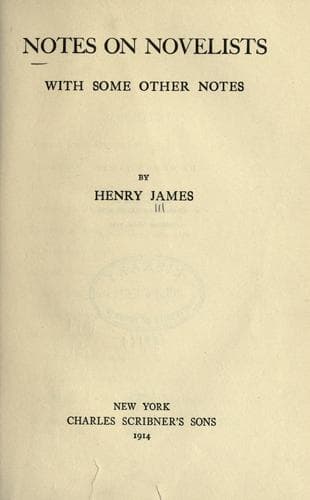
Notes on Novelists, with Some Other NotesJames, Henry
History
Notes on Novelists, with Some Other Notes
James, Henry
Fiction -- History and criticism; Novelists
We begin to ask ourselves at an early stage what this queer passion may
be in the representation of which the sense of beauty ostensibly finds
its richest expression and which is yet attended by nothing else at
all—neither duration, nor propagation, nor common kindness, nor common
consistency with other relations, common congruity with the rest of
life—to make its importance good. If beauty is the supreme need so let
it be; nothing is more certain than that we can never get too much of it
if only we get it of the right sort. It is therefore on this very
ground—the ground of its own sufficiency—that Signor D’Annunzio’s
invocation of it collapses at our challenge. The vulgarity comes from
the disorder really introduced into values, as I have called them; from
the vitiation suffered—that we should have to record so mean an
accident—by taste, impeccable taste, itself. The truth of this would
come out fully in copious examples, now impossible; but it is not too
much to say, I think, that in every principal situation presented the
fundamental weakness causes the particular interest to be inordinately
compromised.
I must not, I know, make too much of “Il Piacere”—one of those works of
promising youth with which criticism is always easy—and I should indeed
say nothing of it if it were also a work of less ability. It really,
however, to my mind, quite gives us the key, all in the morning early,
to our author’s general misadventure. Andrea Sperelli is the key; Donna
Maria is another key of a slightly different shape. They have neither of
them the esthetic importance, any more than the moral, that their
narrator claims for them and in his elaborate insistence on which he has
so hopelessly lost his way. If they _were_ important—by which I mean if
they showed in any other light than that of their particular erotic
exercise—they would justify the claim made for them with such superior
art. They have no general history, since their history is only, and
immediately and extravagantly, that of their too cheap and too easy
romance. Why should the career of the young man be offered as a sample
of pathetic, of tragic, of edifying corruption?—in which case it might
indeed be matter for earnest exhibition. The march of corruption, the
insidious influence of propinquity, opportunity, example, the ravage of
false estimates and the drama of sterilising passion—all this is a
thinkable theme, thinkable especially in the light of a great talent.
But for Andrea Sperelli there is not only no march, no drama, there is
not even a weakness to give him the semblance of dramatic, of plastic
material; he is solidly, invariably, vulgarly strong, and not a bit more
corrupt at the end of his disorders than at the beginning. His
erudition, his intellectual accomplishments and elevation, are too
easily spoken for; no view of him is given in which we can feel or taste
them. Donna Maria is scarcely less signal an instance of the apparent
Public-domain text, read in full here on John Shaqi.
Reviews
Reviews
No reviews yet
Be the first to share your thoughts on this work.
Elsewhere in the archive
Join the Discussion
Join the discussion
Sign in to leave a comment or review.
Sign InorCreate an account