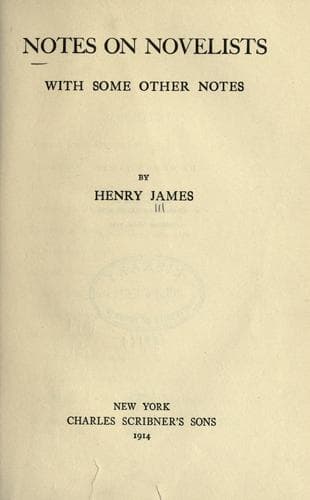
Notes on Novelists, with Some Other NotesJames, Henry
History
Notes on Novelists, with Some Other Notes
James, Henry
Fiction -- History and criticism; Novelists
derived from it a word of support for my position. The question of our
possible rejoinder to the scorn of societies otherwise affected I must
leave for some other connection. The point is—if point I may expect to
obtain any countenance to its being called—that, in spite of our great
Dickens and, in a minor degree, of our great George Eliot, the
limitations of our practice are elsewhere than among ourselves pretty
well held to have put us out of court. The thing least conceded to us
moreover is that we handle at all frankly—if we put forward such a
claim—even our own subject-matter or in other words our own life. “Your
own is all we want of you, all we should like to see. But that your
system really touches your own is exactly what we deny. Never, never!”
For what it really comes to is that practically we, of all people in the
world, are accused of a system. Call this system a conspiracy of
silence, and the whole charge is upon us.
The fact of the silence, whether or no of the system, is fortunately all
that at present concerns us. Did this not happen to be the case nothing
could be more interesting, I think, than to follow somewhat further
several of the bearings of the matter, which would bring us face to face
with some wonderful and, I hasten to add, by no means doubtless merely
disconcerting truths about ourselves. It has been given us to read a
good deal, in these latter days, about _l’âme Française_ and _l’âme
Russe_—and with the result, in all probability, of our being rather
less than more penetrated with the desire, in emulation of these
opportunities, to deliver ourselves upon the English or the American
soul. There would appear to be nothing we are totally conscious of that
we are less eager to reduce to the mere expressible, to hand over to
publicity, current journalistic prose aiding, than either of these fine
essence; and yet incontestably there are neighbourhoods in which we feel
ourselves within scent and reach of them by something of the same sense
that in thick forests serves the hunter of great game. He may not quite
touch the precious presence, but he knows when it is near. So somehow we
know that the “Anglo-Saxon” soul, the modern at least, is not far off
when we frankly consider the practice of our race—comparatively recent
though it be—in taking for granted the “innocence” of literature.
Public-domain text, read in full here on John Shaqi.
Reviews
Reviews
No reviews yet
Be the first to share your thoughts on this work.
Elsewhere in the archive
Join the Discussion
Join the discussion
Sign in to leave a comment or review.
Sign InorCreate an account