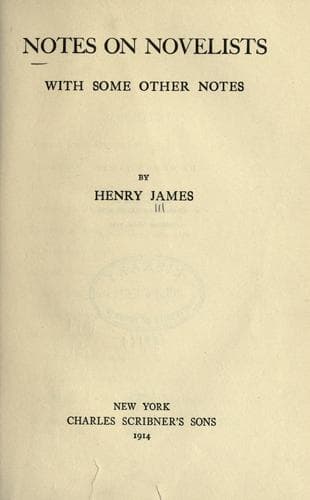
Notes on Novelists, with Some Other NotesJames, Henry
History
Notes on Novelists, with Some Other Notes
James, Henry
Fiction -- History and criticism; Novelists
MATILDE SERAO
Few attentive readers, I take it, would deny that the English
novelist—from whom, in this case, there happens to be even less
occasion than usual for distinguishing the American—testifies in his
art much more than his foreign comrade, from whatever quarter, to the
rigour of convention. There are whole sides of life about which he has
as little to say as possible, about which he observes indeed in general
a silence that has visibly ended by becoming for the foreign comrade his
great characteristic. He strikes the spectator as having with a
misplaced humility consented once for all to be admonished as to what he
shall or shall not “mention”—and to be admonished in especial by an
authority altogether indefinite. He subscribes, when his turn comes
round, to an agreement in the drawing-up of which he has had no hand; he
sits down to his task with a certain received canon of the “proper”
before his eyes. The critic I am supposing reproaches him, naturally, in
this critic’s way, with a marked failure ever to challenge, much less to
analyse, that conception; with having never, as would appear, so much as
put to himself in regard to most of the matters of which he makes his
mystery the simple question “Proper to what?” How can any authority,
even the most embodied, asks the exponent of other views, decide for us
in advance what shall in any case be proper—with the consequent
implication of impropriety—to our given subject?
The English novelist would, I imagine, even sometimes be led on to
finding that he has practically had to meet such an overhauling by a
further admission, though an admission still tacit and showing him not a
little shy of the whole discussion—principles and formulas being in
general, as we know, but little his affair. Would he not, if off his
guard, have been in peril of lapsing into the doctrine—suicidal when
reflected upon—that there may be also an _a priori_ rule, a “Thou shalt
not,” if not a “Thou shalt,” as to treatable subjects themselves? Then
it would be that his alien foe might fairly revel in the sense of having
him in a corner, laughing an evil laugh to hear him plead in explanation
that it is exactly _most_ as to the subject to be treated that he feels
the need laid upon him to conform. What is he to do when he has an idea
to embody, we might suspect him rashly to inquire, unless, frankly to
ask himself in the first place of _all_ if it be proper? Not indeed—we
catch the reservation—that he is consciously often accessible to ideas
for which that virtue may not be claimed. Naturally, however, still,
such a plea only brings forth for his interlocutor a repetition of the
original appeal: “Proper to what?” There is only one propriety the
painter of life can ask of his morsel of material: Is it, or is it not,
of the stuff of life? So, in simplified terms at any rate, I seem to
hear the interchange; to which I need listen no longer than thus to have
Public-domain text, read in full here on John Shaqi.
Reviews
Reviews
No reviews yet
Be the first to share your thoughts on this work.
Elsewhere in the archive
Join the Discussion
Join the discussion
Sign in to leave a comment or review.
Sign InorCreate an account