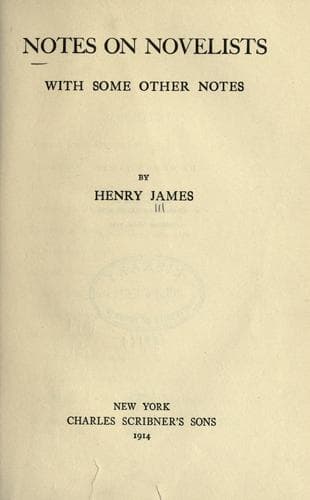
Notes on Novelists, with Some Other NotesJames, Henry
History
Notes on Novelists, with Some Other Notes
James, Henry
Fiction -- History and criticism; Novelists
Practically chartered then she is further happy—since they both
minister to ease—in two substantial facts: she is a daughter of the
veritable south and a product of the contemporary newspaper. A
Neapolitan by birth and a journalist by circumstance, by marriage and in
some degree doubtless also by inclination, she strikes for us from the
first the note of facility and spontaneity and the note of initiation
and practice. Concerned, through her husband, in the conduct of a
Neapolitan morning paper, of a large circulation and a radical colour,
she has, as I infer, produced her novels and tales mainly in such
snatches of time and of inspiration as have been left her by urgent
day-to-day journalism. They distinctly betray, throughout, the
conditions of their birth—so little are they to the literary sense
children of maturity and leisure. On the question of style in a foreign
writer it takes many contributive lights to make us sure of our ground;
but I feel myself on the safe side in conceiving that this lady, full of
perception and vibration, can not only not figure as a purist, but must
be supposed throughout, in spite of an explosive eloquence, to pretend
but little to distinction of form: which for an Italian is a much graver
predicament than for one of our shapeless selves. That, however, would
perhaps pass for a small quarrel with a writer, or rather with a talker
and—for it is what one must most insist on—a _feeler_, of Matilde
Serao’s remarkable spontaneity. Her Neapolitan nature is by itself a
value, to whatever literary lapses it may minister. A torch kindled at
that flame can be but freely waved, and our author’s arm has a fine
action. Loud, loquacious, abundant, natural, happy, with luxurious
insistences on the handsome, the costly and the fleshly, the fine
persons and fine clothes of her characters, their satin and velvet,
their bracelets, rings, white waistcoats, general appointments and
bedroom furniture, with almost as many repetitions and as free a tongue,
in short, as Juliet’s nurse, she reflects at every turn the wonderful
mixture that surrounds her—the beauty, the misery, the history, the
light and noise and dust, the prolonged paganism and the renewed
reactions, the great style of the distant and the past and the generally
compromised state of the immediate and the near. These things were all
in the germ for the reader of her earlier novels—they have since only
gathered volume and assurance—so that I well remember the impression
made on me, when the book was new (my copy, apparently of the first
edition, bears the date of 1885), by the rare energy, the immense
_disinvoltura_, of “La Conquista di Roma.” This was my introduction to
the author, in consequence of which I immediately read “Fantasia” and
the “Vita e Avventure di Riccardo Joanna,” with some smaller pieces;
after which, interrupted but not detached, I knew nothing more till, in
the course of time, I renewed acquaintance on the ground of “Il Paese di
Public-domain text, read in full here on John Shaqi.
Reviews
Reviews
No reviews yet
Be the first to share your thoughts on this work.
Elsewhere in the archive
Join the Discussion
Join the discussion
Sign in to leave a comment or review.
Sign InorCreate an account