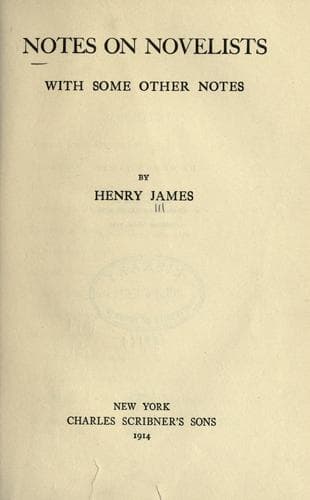
Notes on Novelists, with Some Other NotesJames, Henry
History
Notes on Novelists, with Some Other Notes
James, Henry
Fiction -- History and criticism; Novelists
Cuccagna,” then, however, no longer in its first freshness. That work
set me straightway to reading everything else I could lay hands on, and
I think therefore that, save “Il Ventre di Napoli” and two or three
quite recent productions that I have not met, there is nothing from our
author that I have not mastered. Such as I find her in everything, she
remains above all things the signal “case.”
If, however, she appears, as I am bound to note, not to have kept the
full promise of her early energy, this is because it has suited her to
move less in the direction—where so much might have awaited her—of
“Riccardo Joanna” and “La Conquista” than in that, on the whole less
happily symptomatic, of “Fantasia.” “Fantasia” is, before all else, a
study of “passion,” or rather of the intenser form of that mystery which
the Italian _passione_ better expresses; and I hasten to confess that
had she not so marked herself an exponent of this specialty I should
probably not now be writing of her. I conceive none the less that it
would have been open to her to favour more that side of her great talent
of which the so powerful “Paese di Cuccagna” is the strongest example.
There is by good fortune in this large miscellaneous picture of
Neapolitan life no _passione_ save that of the observer curiously and
pityingly intent upon it, that of the artist resolute at any cost to
embrace and reproduce it. Admirably, easily, convincingly objective, the
thing is a sustained panorama, a chronicle of manners finding its unity
in one recurrent note, that of the consuming lottery-hunger which
constitutes the joy, the curse, the obsession and the ruin, according to
Matilde Serao, of her fellow-citizens. Her works are thus divided by a
somewhat unequal line, those on one side of which the critic is tempted
to accuse her of having not altogether happily sacrificed to those on
the other. When she for the most part invokes under the name of
_passione_ the main explanation of the mortal lot it is to follow the
windings of this clue in the upper walks of life, to haunt the
aristocracy, to embrace the world of fashion, to overflow with clothes,
jewels and promiscuous intercourse, all to the proportionate eclipse of
her strong, full vision of the more usually vulgar. “La Conquista” is
the story of a young deputy who comes up to the Chamber, from the
Basilicata, with a touching candour of ambition and a perilous ignorance
of the pitfalls of capitals. His dream is to conquer Rome, but it is by
Rome naturally that he is conquered. He alights on his political twig
with a flutter of wings, but has reckoned in his innocence without the
strong taste in so many quarters for sport; and it is with a charge of
shot in his breast and a drag of his pinions in the dust that he takes
his way back to mediocrity, obscurity and the parent nest. It is from
the ladies—as was indeed even from the first to be expected with
Serao—that he receives his doom; _passione_ is in these pages already
Public-domain text, read in full here on John Shaqi.
Reviews
Reviews
No reviews yet
Be the first to share your thoughts on this work.
Elsewhere in the archive
Join the Discussion
Join the discussion
Sign in to leave a comment or review.
Sign InorCreate an account