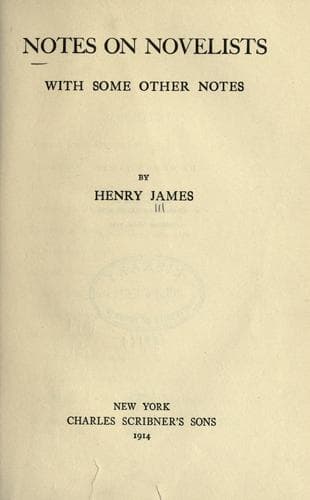
Notes on Novelists, with Some Other NotesJames, Henry
History
Notes on Novelists, with Some Other Notes
James, Henry
Fiction -- History and criticism; Novelists
These, however, are minor questions—pertinent only as connecting
themselves with the more serious side of her talent. We may rejoice in
such a specimen of it as is offered by the too brief series of episodes
of “The Romance of the Maiden.” These things, dealing mainly with the
small miseries of small folk, have a palpable truth, and it is striking
that, to put the matter simply, Madame Serao is at her best almost in
direct proportion as her characters are poor. By poor I mean literally
the reverse of rich; for directly they _are_ rich and begin, as the
phrase is, to keep their carriage, her taste totters and lapses, her
style approximates at moments to that of the ladies who do the fashions
and the letters from the watering-places in the society papers. She has
acutely and she renders with excellent breadth the sense of benighted
lives, of small sordid troubles, of the general unhappy youthful (on the
part of her own sex at least) and the general more or less starved
plebeian consciousness. The degree to which it testifies to all this is
one of the great beauties of “Il Paese di Cuccagna,” even if the moral
of that dire picture be simply that in respect to the gaming-passion,
the madness of “numbers,” no walk of life at Naples is too high or too
low to be ravaged. Beautiful, in “Il Romanzo della Fanciulla,” are the
exhibitions of grinding girl-life in the big telegraph office and in the
State normal school. The gem of “Gli Amanti” is the tiny tale of
“Vicenzella,” a masterpiece in twenty small pages—the vision of what
three or four afternoon hours could contain for a slip of a creature of
the Naples waterside, a poor girl who picks up a living by the cookery
and sale, on the edge of a parapet, of various rank dismembered polyps
of the southern sea, and who is from stage to stage despoiled of the
pence she patiently pockets for them by the successive small emissaries
of her artful, absent lover, constantly faithless, occupied, not too far
off, in regaling a lady of his temporary preference, and proportionately
clamorous for fresh remittances. The moment and the picture are but a
scrap, yet they are as large as life.
Public-domain text, read in full here on John Shaqi.
Reviews
Reviews
No reviews yet
Be the first to share your thoughts on this work.
Elsewhere in the archive
Join the Discussion
Join the discussion
Sign in to leave a comment or review.
Sign InorCreate an account