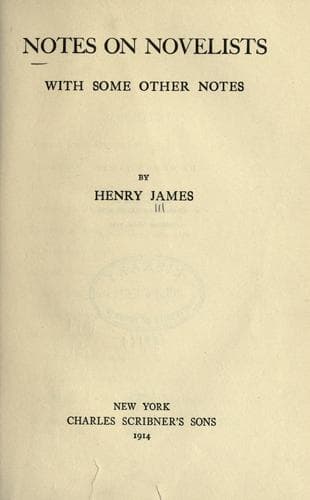
Notes on Novelists, with Some Other NotesJames, Henry
History
Notes on Novelists, with Some Other Notes
James, Henry
Fiction -- History and criticism; Novelists
at the door and soon arrives; _passione_ rapidly enough passes its
sponge over everything not itself.
In “Cuore Infermo,” in “Addio Amore,” in “Il Castigo,” in the two
volumes of “Gli Amanti” and in various other pieces this effacement is
so complete that we see the persons concerned but in the one relation,
with every other circumstance, those of concurrent profession,
possession, occupation, connection, interest, amusement, kinship,
utterly superseded and obscured. Save in the three or four books I have
named as exceptional the figures evoked are literally professional
lovers, “available,” as the term is, for _passione_ alone: which is the
striking sign, as I shall presently indicate, of the extremity in which
her enjoyment of the freedom we so often have to envy has strangely
landed our author. “Riccardo Joanna,” which, like “La Conquista,” has
force, humour and charm, sounding with freshness the note of the general
life, is such a picture of certain of the sordid conditions of Italian
journalism as, if I may trust my memory without re-perusal, sharply and
pathetically imposes itself. I recall “Fantasia” on the other hand as
wholly _passione_—all concentration and erotics, the latter practised
in this instance, as in “Addio Amore,” with extreme cruelty to the
“good” heroine, the person innocent and sacrificed; yet this volume too
contributes its part in the retrospect to that appearance of marked
discipleship which was one of the original sources of my interest.
Nothing could more have engaged one’s attention in these matters at that
moment than the fresh phenomenon of a lady-novelist so confessedly
flushed with the influence of Émile Zola. Passing among ourselves as a
lurid warning even to workers of his own sex, he drew a new grace from
the candid homage—all implied and indirect, but, as I refigure my
impression, not the less unmistakable—of that half of humanity which,
let alone attempting to follow in his footsteps, was not supposed even
to turn his pages. There is an episode in “Fantasia”—a scene in which
the relations of the hero and the “bad” heroine are strangely
consolidated by a visit together to a cattle-show—in which the courage
of the pupil has but little to envy the breadth of the master. The hot
day and hot hour, the heavy air and the strong smells, the great and
small beasts, the action on the sensibilities of the lady and the
gentleman of the rich animal life, the collapse indeed of the lady in
the presence of the prize bull—all these are touches for which luckily
our author has the warrant of a greater name. The general picture, in
“Fantasia,” of the agricultural exhibition at Caserta is in fact not the
worse at any point for a noticeable echo of more than one French model.
Would the author have found so full an occasion in it without a fond
memory of the immortal Cornices of “Madame Bovary”?
Public-domain text, read in full here on John Shaqi.
Reviews
Reviews
No reviews yet
Be the first to share your thoughts on this work.
Elsewhere in the archive
Join the Discussion
Join the discussion
Sign in to leave a comment or review.
Sign InorCreate an account