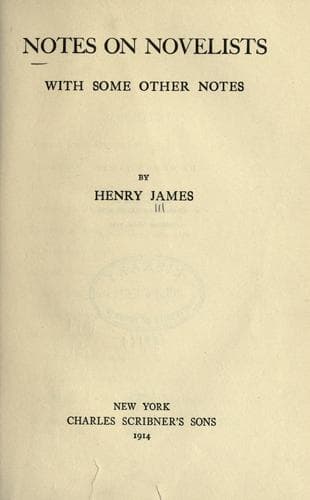
Notes on Novelists, with Some Other NotesJames, Henry
History
Notes on Novelists, with Some Other Notes
James, Henry
Fiction -- History and criticism; Novelists
The effect of this is extraordinarily to falsify the total show and to
present the particular affair—the intimacy in hand for the moment,
though the moment be but brief—as taking place in a strange false
perspective, a denuded desert which experience surely fails ever to give
us the like of and the action of which on the faculty of observation in
the painter is anything but favourable. It strikes at the root, in the
impression producible and produced, of discrimination and irony, of
humour and pathos. Our present author would doubtless contend on behalf
of the works I have mentioned that pathos at least does abound in
them—the particular bitterness, the inevitable despair that she again
and again shows to be the final savour of the cup of _passione_. It
would be quite open to her to urge—and she would be sure to do so with
eloquence—that if we pusillanimously pant for a moral, no moral really
can have the force of her almost inveterate evocation of the absolute
ravage of Venus, the dry desolation that in nine cases out of ten Venus
may be perceived to leave behind her. That, however, but half meets our
argument—which bears by no means merely on the desolation behind, but
on the desolation before, beside and generally roundabout. It is not in
short at all the moral but the fable itself that in the exclusively
sexual light breaks down and fails us. Love, at Naples and in Rome, as
Madame Serao exhibits it, is simply unaccompanied with any interplay of
our usual conditions—with affection, with duration, with circumstances
or consequences, with friends, enemies, husbands, wives, children,
parents, interests, occupations, the manifestation of tastes. Who are
these people, we presently ask ourselves, who love indeed with
fury—though for the most part with astonishing brevity—but who are so
without any suggested situation in life that they can only strike us as
loving for nothing and in the void, to no gain of experience and no
effect of a felt medium or a breathed air. We know them by nothing but
their convulsions and spasms, and we feel once again that it is not the
passion of hero and heroine that gives, that can ever give, the heroine
and the hero interest, but that it is they themselves, with the ground
they stand on and the objects enclosing them, who give interest to their
passion. This element touches us just in proportion as we see it mixed
with other things, with all the things with which it has to reckon and
struggle. There is moreover another reflection with which the pathetic
in this connection has to count, even though it undermine not a little
the whole of the tragic effect of the agitations of _passione_. Is it,
ruthlessly speaking, certain that the effect most consonant, for the
spectator, with truth is half as tragic as it is something else? Should
not the moral be sought in the very different quarter where the muse of
comedy rather would have the last word? The ambiguity and the difficulty
Public-domain text, read in full here on John Shaqi.
Reviews
Reviews
No reviews yet
Be the first to share your thoughts on this work.
Elsewhere in the archive
Join the Discussion
Join the discussion
Sign in to leave a comment or review.
Sign InorCreate an account